

Chain of Responsibility Compliance for Heavy Vehicles
TL;DR
Under the Heavy Vehicle National Law (HVNL), every party in the supply chain shares legal responsibility for heavy vehicle safety. Operators, consignors, loaders, schedulers, and directors all have Chain of Responsibility (CoR) obligations.
The HVNL primary duty requires each party to ensure, so far as is reasonably practicable, that their conduct does not create safety risks. Documented, proactive action is the standard. Waiting for a failure does not meet it.
Pitcrew AI’s Autonomous Inspection System (AIS) generates timestamped thermal inspection records for every vehicle on every pass. These records provide audit-ready evidence of continuous vehicle condition monitoring.
Heavy vehicles are involved in approximately 18% of all road crash deaths in Australia, with 190 lives lost in the 2024-25 financial year (National Road Safety Strategy data).
What Is Chain of Responsibility and Who Does It Apply To?
Chain of Responsibility (CoR) is the legal framework under the Heavy Vehicle National Law (HVNL, Part 5) that holds every party in the heavy vehicle supply chain accountable for transport safety. CoR applies to operators, drivers, prime contractors, consignors, packers, loaders, unloaders, schedulers, and company directors. If your decisions or actions influence how a heavy vehicle is loaded, maintained, or operated, you have a CoR obligation.
The HVNL is administered by the National Heavy Vehicle Regulator (NHVR) and applies in Queensland, New South Wales, Victoria, South Australia, Tasmania, and the Australian Capital Territory. Western Australia and the Northern Territory operate under their own heavy vehicle legislation with broadly similar duty requirements.
Which parties are responsible under national heavy vehicle law?
The HVNL makes every party whose actions affect heavy vehicle safety responsible, not just the driver behind the wheel. That includes operators, prime contractors, consignors, packers, loaders, unloaders, schedulers, and company directors. Each party must manage the safety risks they can influence.
What changed with the 2018 amendments?
The amendments that commenced on 1 October 2018 introduced a primary duty that sits above the existing prescriptive offence framework. Every party in the supply chain must now ensure, so far as is reasonably practicable, that their conduct does not directly or indirectly cause or contribute to safety risks involving heavy vehicles. Every party needs documented evidence of what they did to manage safety risks. Verbal assurances and unrecorded walkarounds are difficult to rely on in a compliance investigation.
What is the penalty for Chain of Responsibility breaches?
The HVNL prescribes penalties in three categories:
| Category | Conduct | Individual | Corporation |
|---|---|---|---|
| Category 1 | Reckless conduct exposing a person to risk of death or serious injury | Up to $300,000 | Up to $3,000,000 |
| Category 2 | Conduct exposing a person to risk of death or serious injury without reasonable excuse | Up to $150,000 | Up to $1,500,000 |
| Category 3 | Failure to comply with the primary duty | Up to $50,000 | Up to $500,000 |
Directors and executive officers can be held personally liable. The NHVR can also issue improvement notices, prohibition orders, and enforceable undertakings. Penalty amounts are HVNL statutory maximums and subject to indexation.
What Does "Reasonably Practicable" Mean for Vehicle Condition Monitoring?
Operators must take positive, documented actions to identify and manage vehicle safety risks. The HVNL primary duty standard of “reasonably practicable” requires weighing the likelihood and severity of harm against the availability and cost of reducing the risk. NHVR guidance makes clear that this must be proactive, not reactive. Waiting for a component to fail and then responding does not meet the standard.
What counts as evidence?
Evidence that supports a CoR compliance position includes:
- Documented inspection records with dates and times
- Records of defects identified and actions taken
- Evidence that monitoring systems are operational
- Records of staff training and competency
The key word is “documented.” An inspection that happened but was not recorded offers little defence in a compliance investigation.
Pitcrew AIS generates this evidence automatically. Every vehicle that passes through the inspection station produces a timestamped thermal record covering brakes, tyres, hubs, and bearings. Anomalies are flagged with severity classifications. As a piece of chain of responsibility compliance software, the data is stored, retrievable, and audit-ready.
How Does the On-Road Pitcrew AIS Work?
The on-road Pitcrew Autonomous Inspection System (AIS) uses three FLIR thermal cameras at a fixed installation point to inspect heavy vehicles as they drive through at operating speed. One camera is positioned below the vehicle path looking upward. One camera is mounted on each side of the lane. Together, they capture a complete thermal profile of every axle, brake, tyre sidewall, hub, and bearing on the vehicle.
Nothing is fitted to the vehicle. The driver does not stop. The inspection takes seconds and produces a full thermal record of every component on every axle, from the prime mover through every trailer in a B-double or multi-combination configuration.
What does asymmetry-based detection mean?
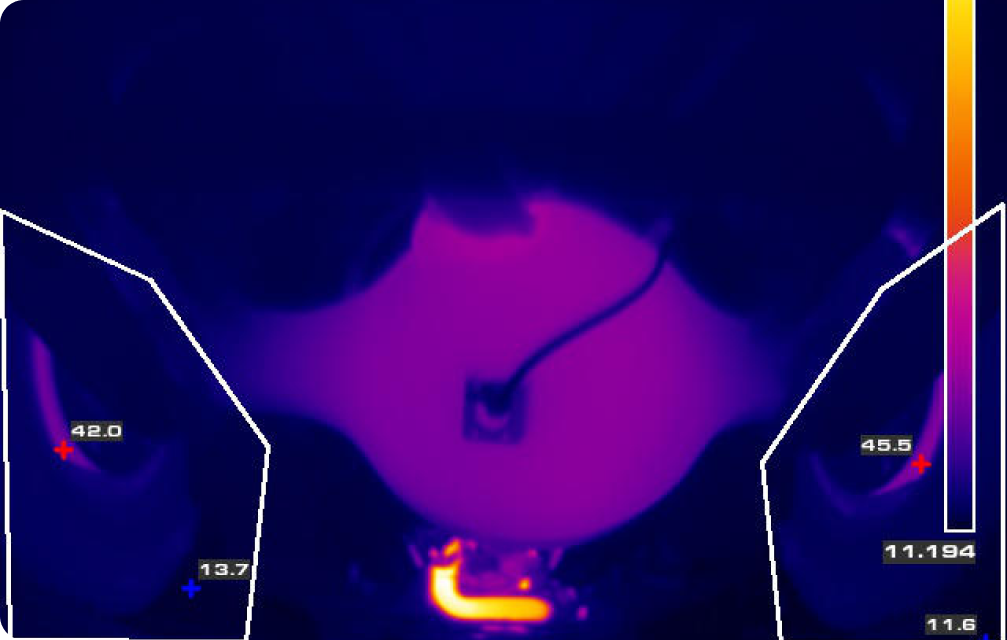
Asymmetry-based detection compares the thermal profile of components on the left side of an axle with the corresponding components on the right side. In normal operation, matched components on the same axle run at similar temperatures. When one side is significantly hotter or colder than the other, it indicates a developing fault.
This approach is more reliable than absolute temperature thresholds because it accounts for ambient conditions, load, speed, and recent braking history. A brake at 180 degrees Celsius might be normal after a long descent. The same reading with the opposite side at 90 degrees indicates a fault. Pitcrew AIS flags the asymmetry, not just the temperature. You can see how thermal imaging surfaces these faults in our guide to detecting tyre faults with thermal imaging.
How Does Automated Inspection Compare to Manual Walkarounds?
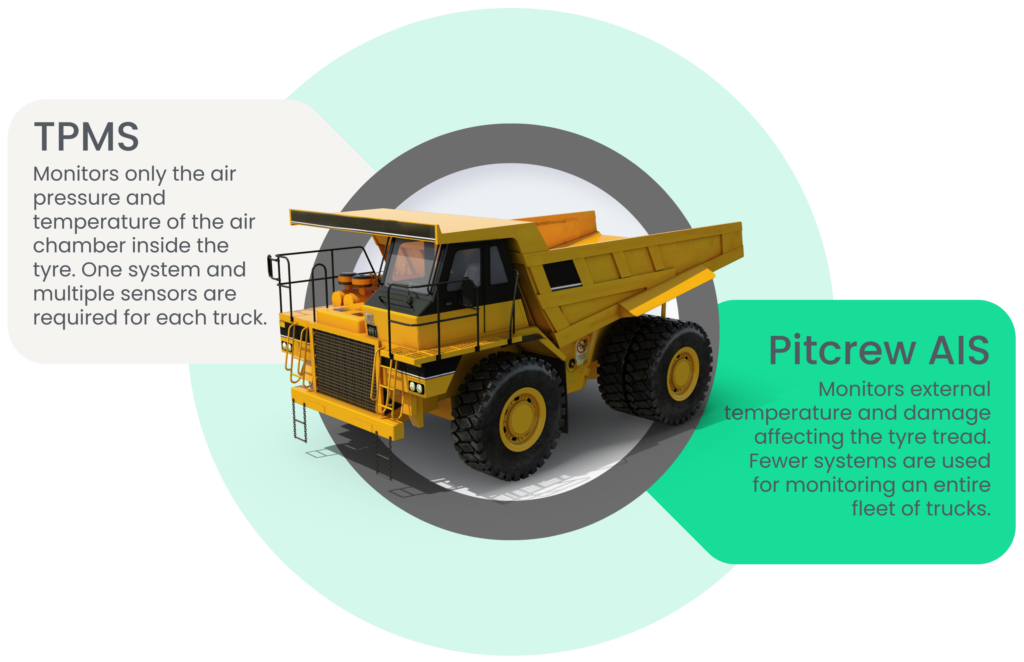
Manual pre-departure walkarounds are a legal requirement and a valuable safety practice. They are also limited by what a driver can see and feel in the time available. Pitcrew AIS does not replace walkarounds. It adds a layer of thermal detection that catches faults developing beneath the surface, days to weeks before they become visible or detectable by hand.
| Inspection Capability | Manual Walkaround | Pitcrew AIS |
|---|---|---|
| Visible tyre damage | Yes | No (thermal only) |
| Tyre pressure (visual check) | Partial (gross underinflation only) | No (detects thermal effects of significant underinflation) |
| Elevated tyre sidewall temperature | No | Yes |
| Dragging or seized brakes | No (unless visible smoke or smell) | Yes |
| Overheating bearings or hubs | No (unless visible smoke or smell) | Yes |
| Asymmetric faults across axles | No | Yes |
| Time required | 15-30+ minutes per vehicle | Seconds (drive-through) |
| Records generated | Manual (if recorded) | Automatic, timestamped, audit-ready |
| Frequency | Pre-departure (once per trip) | Every pass through the station |
The two approaches are complementary. Walkarounds catch visible damage, loose components, and load security issues. Pitcrew AIS catches thermal faults that are invisible to the eye. This is the difference between predictive and reactive maintenance in practice.
What Are the Dangerous Goods Vehicle Inspection Requirements?
Vehicles carrying dangerous goods must comply with the Australian Dangerous Goods Code (current edition), which requires vehicles to be maintained in a safe and roadworthy condition with particular attention to brakes, tyres, and electrical systems. Western Australia’s Regulation 170A, effective April 2025, now mandates tyre temperature monitoring for ammonium nitrate transport vehicles, following a series of public road incidents involving heavy vehicles carrying explosives. A dragging brake on a dangerous goods vehicle is not just a maintenance issue. It is a heat source on a vehicle carrying flammable, explosive, or hazardous cargo.
Pitcrew AIS detects the thermal indicators of brake and tyre faults on dangerous goods vehicles using the same drive-through inspection applied to all heavy vehicles. For operators with dangerous goods obligations, the inspection data provides documented evidence that vehicle condition was actively monitored. Pitcrew AIS does not replace ADG Code obligations, but strengthens the condition-monitoring evidence behind them. See more on dangerous goods transport compliance.
Case example: At one northern Australian dangerous goods transport operation, Pitcrew AIS detected a developing tyre thermal anomaly on a loaded ammonium nitrate vehicle, enabling planned tyre replacement before the next loaded run. The detection was made days before the tyre would have progressed to catastrophic failure under operational stress. The timestamped thermal record documented the condition monitoring and the intervention, supporting compliance with transport safety requirements.
Frequently Asked Questions
No. Pitcrew AIS is a fixed roadside installation. Three FLIR thermal cameras capture the thermal profile of every vehicle as it passes through at speed. No vehicle modifications or driver interaction required.
Any heavy vehicle that passes through the inspection station, including prime movers, B-doubles, multi-combination vehicles, and rigid trucks. The system inspects every axle on every trailer, regardless of configuration.
The inspection happens at normal driving speed. The vehicle does not stop. Every axle, brake, tyre, hub, and bearing is inspected in seconds.
Pitcrew AIS detects the thermal effects of significant underinflation. An underinflated tyre flexes more under load, generating elevated sidewall temperatures. The system identifies this thermal sign