

Compliance
NVHR ON-ROAD COMPLIANCE MONITORING FOR HEAVY VEHICLES
Automated thermal screening replaces subjective roadside inspections with objective, auditable vehicle condition data to support Chain of Responsibility (CoR) due diligence. Pitcrew AIS scans every heavy vehicle for on-road compliance at normal road speed, detecting brake, tyre, hub, and bearing defects using FLIR thermal imaging. Each pass generates a timestamped inspection record that supports the “reasonable steps” defence under Australia’s Heavy Vehicle National Law (HVNL).
Why do manual roadside inspections fail the CoR test?
Manual roadside inspections rely on small samples, subjective judgement, and available personnel. Inspectors assess a fraction of vehicles on any given route, using visual checks that miss developing thermal faults invisible to the human eye. Under the HVNL, these gaps represent unmanaged risk. Sample-based regimes cover too few vehicle movements to provide the continuous, documented evidence that modern CoR compliance requires.
| Issue | Manual inspection | Pitcrew AIS |
|---|---|---|
| Coverage | Sample-based | 100% of passing vehicles |
| Consistency | Subjective inspector judgement | Objective thermal rules and AI logic |
| Throughput | Requires stops and queuing | Drive-through at normal road speed |
| Evidence | Paper or checklist-based | Digital, timestamped thermal records |
How does Pitcrew AIS automate compliance screening?
Pitcrew AIS uses three FLIR thermal cameras (one in-road sensor and two side-mounted units) to scan vehicles as they pass at normal road speed. No stopping, no queuing, no driver action required.
-
01
Scan
Three FLIR thermal cameras (one in-road, two side-mounted) scan each vehicle at normal road speed across all axle groups.
-
02
Compare
Computer vision compares temperatures across axle groups to identify abnormal asymmetry. A brake running hotter than its opposite-side counterpart indicates a dragging or underperforming component. This comparative logic accounts for operational heat from braking or site topography, reducing false alerts while identifying early-stage failure.
-
03
Record
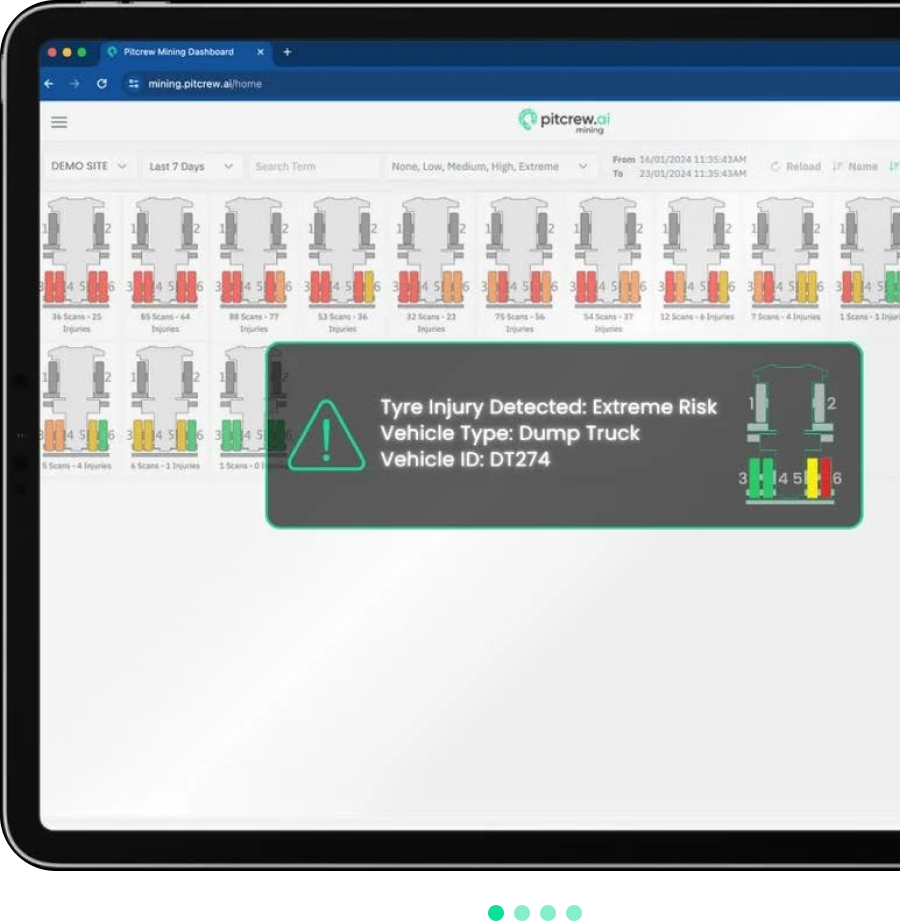
Every passage produces an audit-ready inspection record, transmitted to the Pitcrew AI cloud platform on AWS for dashboard viewing, REST API export, or CSV download into existing compliance and maintenance systems.
What safety-critical defects does on-road heavy vehicle monitoring detect?
Pitcrew AIS identifies four categories of defects across all axle positions on B-doubles and multi-combination heavy vehicles. The useful signal is comparative temperature behaviour across each axle group.

Brake system faults
Overheating, dragging, or underperforming brakes. Asymmetric heat across an axle indicates uneven performance that increases stopping distances.
Tyre condition
Inner and outer sidewall thermal anomalies indicating internal separation, underinflation, or progressive degradation — signatures that appear before external rubber damage is visible.
Bearing and hub failures
Elevated hub temperatures indicating developing bearing failure. Identifying a hub running hotter than its counterpart prevents wheel-off events.
Load distribution indicators
Thermal asymmetry across axles can indicate friction differences that correlate with weight distribution issues, which may accelerate component wear.
Trusted by





How does NHVR on-road compliance monitoring support Chain of Responsibility compliance?
Automated thermal inspection creates consistent, timestamped records that demonstrate a fleet is actively screening for heat-related safety defects. These records help satisfy “reasonable steps” requirements under the HVNL and align with the National Heavy Vehicle Regulator (NHVR) framework for industry safety management.
Pitcrew AIS supports the compliance framework in three ways:
- Complete coverage. A record for every vehicle, not a random sample.
- Objective logic. Repeatable thermal comparison rather than subjective visual inspection.
- Audit-ready trail. Data for investigations, internal audits, or regulator reviews.
While not yet tested in case law, automated records provide a documented due diligence trail that manual sampling cannot match. For compliance teams, this means better inspection coverage, clearer escalation triggers, and a stronger evidence base.
Our Technology
What are the deployment options for compliance screening?
Pitcrew AIS installs at depot entry and exit points, weigh stations, or designated inspection facilities. The system operates 24 hours a day, 7 days a week with no on-site operator required. With systems deployed globally across diverse climates, from arid Western Australia to high-altitude South American operations, the platform is proven in harsh environments.
| Feature | Specification |
|---|---|
| Deployment locations | Depot entry/exit, weigh stations, inspection lanes |
| Operation | Continuous, 24/7, no on-site operator |
| Vehicle impact | No fitment, no stop required |
| Sensors | 3x FLIR thermal cameras (1 in-road, 1 each side) |
| Outputs | Alerts, timestamped records, inspection history |
| Integration | REST API, CSV export, dashboard access |
For operators with multiple depot locations, the cloud platform aggregates inspection data across all sites into a single compliance view.
Explore Regulatory Applications
Learn how automated thermal inspection supports enforcement and NHVR heavy vehicle compliance operations at scale.
Frequently Asked Questions
NHVR safety and compliance refers to the regulatory framework administered by the National Heavy Vehicle Regulator covering vehicle standards, fatigue, mass, dimension, and Chain of Responsibility obligations under the HVNL. The goal is to keep heavy vehicles safe to operate and hold every party in the supply chain accountable for managing risk. Pitcrew AIS generates timestamped inspection records that support NHVR heavy vehicle compliance and the “reasonable steps” due diligence framework. It is a due diligence tool, not a legal certification device. For current guidance, refer to the National Heavy Vehicle Regulator (NHVR) at nhvr.gov.au.
Yes. NHVR authorised officers have powers under the HVNL to stop, inspect, and search heavy vehicles to check compliance with vehicle standards, mass and dimension limits, and load restraint. Officers can also direct a driver to a weigh station or inspection site. Automated on-road heavy vehicle monitoring helps operators present objective condition data and pass these checks with a documented record of every vehicle movement.
The NHVR is the regulator that administers and enforces the Heavy Vehicle National Law day to day, including inspections, accreditation, and compliance. The National Transport Commission (NTC) is a policy body that develops and reviews national transport reforms and recommends changes to the law. In short, the NTC shapes the rules and the NHVR enforces them.
The on-road system screens B-doubles and multi-combination heavy vehicles, the configurations common in long-haul transport, mining logistics, and freight operations. It covers heavy vehicles over 4.5 tonnes GVM within HVNL scope. Vehicles pass through at normal road speed with no driver action required.
Inspection records are retained in the Pitcrew AI cloud platform and available for export at any time. Retention periods can be configured to meet regulatory requirements. All records are timestamped and include thermal images, axle-by-axle condition data, and pass/flag status. Data exports via REST API and CSV.
Dangerous goods operations benefit from non-contact screening of brakes, tyres, hubs, and bearings before a fault escalates on-road. Western Australia’s Regulation 170A, effective April 2025, now requires tyre temperature monitoring for vehicles carrying ammonium nitrate, following the 2022 Great Central Road explosion. Automated inspection records document vehicle condition before and after dangerous goods movements, supporting dangerous goods compliance with transport safety requirements. Early identification of abnormal heat avoids adding manual touchpoints in high-consequence environments.
The information on this page is general guidance only and does not constitute legal advice. Chain of Responsibility compliance varies by jurisdiction. Operators should consult qualified legal counsel and contact the National Heavy Vehicle Regulator for specific compliance obligations.