

How Thermal Imaging Improves Safety in Mining
TL;DR
Heat is the earliest honest signal a heavy vehicle gives before something fails. A belt separation inside an off-the-road tyre casing generates friction heat long before the tread shows a bulge, and a dragging brake runs hot long before smoke appears. Thermal imaging reads that signal on every pass.
Key Takeaways
- Thermal imaging in mining identifies abnormal heat patterns in mobile equipment before they develop into tyre failures, component damage, fires or unplanned downtime.
- The Pitcrew Autonomous Inspection System (AIS) captures a full vehicle thermal profile on every pass, with no vehicle modifications, stoppages or production delays.
- Off-The-Road (OTR) tyre tread separations present as localised heat zones 20–50°C above the surrounding tread, and multi-pass trending with cross-axle comparison picks up small, persistent differentials well before they reach alert thresholds.
- Thermal inspection complements, rather than replaces, Tyre Pressure Monitoring Systems (TPMS), pre-start inspections and the other layers of a tyre management programme.
- Tyres, brakes and bearings account for 74% of non-impact haul truck fire initiations, making early thermal anomaly detection a practical safety control.
How does thermal imaging work in mining?
Thermal imaging detects infrared energy radiated from equipment surfaces, allowing maintenance teams to identify abnormal temperature patterns that are invisible to visual cameras and the naked eye. Thermography is simply the measurement and interpretation of those surface temperature patterns.
Longwave infrared (LWIR) cameras sense radiation in the 7.5–14 micrometre band. That distinction matters. A visual camera records light reflected off a surface; a thermal camera records heat emitted from within a component. No amount of resolution lets a visual camera see friction heat building between separated belt layers inside a tyre casing, because the information isn’t in the reflected light. It’s a difference in physics, not pixels.
Tyres happen to be an unusually good thermal target. Rubber has an emissivity of roughly 0.95, so about 95% of the detected radiation is genuine emission from the tyre and only 5% is environmental reflection. Useful readings come from relative analysis rather than a single absolute number: one area of a tyre compared against adjacent areas, against previous passes, and against the equivalent position on the other side of the truck. Differentials and trend changes carry the diagnostic weight.
Where is thermal imaging used across mining equipment?
Thermal imaging applies anywhere heat accompanies load, friction or electrical resistance, and Pitcrew AIS is built to inspect heavy vehicles as they travel through a fixed inspection point at operating speed. Fixed-plant thermography covers conveyor idlers, motors, gearboxes, electrical connections and processing equipment. Mobile equipment is a separate discipline, and it’s where haul fleet risk concentrates.
Pitcrew AIS captures four component groups in the vehicle thermal profile on every pass:
- Tyres — tread surface temperatures, localised belt separation signatures, underinflation-related heat build-up and the progression of existing injuries.
- Brake assemblies — dragging brakes, general overheating and temperature asymmetry between matching wheel positions.
- Wheel hubs and bearings — elevated bearing temperatures and the heat conducted outward through the wheel end.
- Drivetrain components — abnormal friction or load-related heat that warrants a closer maintenance assessment.
Analysis scope differs by configuration. The mining configuration focuses on tyre thermal signatures. The on-road configuration analyses brake, bearing, hub and tyre sidewall asymmetry. Both are fleet-agnostic, working across crewed fleets and Autonomous Haulage System (AHS) operations from CAT 793/797 through Komatsu 830E/930E, Liebherr T264 and Hitachi EH5000, and tyre sizes 27.00R49 to 59/80R63.
What thermal signatures can indicate a developing fault?
A thermal anomaly is a temperature pattern that differs materially from the surrounding component, from an equivalent component elsewhere on the vehicle, or from its established operating baseline. Interpretation depends on all three references plus multi-pass trending, which is what separates a genuine defect from a hot afternoon.
Normal OTR haul truck tyre surface temperatures commonly sit around 60–80°C in operation, depending on ambient conditions, load and haul profile. A developing separation runs 20–50°C above the surrounding tread in the affected zone. Multi-pass trending and cross-axle comparison pick up small, persistent differentials well before they reach alert thresholds, which puts detection ahead of any visible deformation.
The tyre signatures worth knowing include localised tread hot spots from friction between separated belt layers, sealed injuries that trap heat beneath the tread, and venting injuries that tend to show a more diffuse pattern. Broad elevation across a whole tyre points elsewhere and is best read alongside TPMS pressure and cavity temperature data.
Brake logic is comparative. A wheel or brake assembly running materially hotter than its opposite number suggests drag, friction or uneven braking effort. Bearings are subtler again: a failing bearing runs approximately 7°C above normal, and because heat conducts through the wheel end, the pattern and component context matter as much as the peak value.
The escalation ladder explains the urgency. Industry fire-safety guidance puts rubber degradation from around 150°C, pyrolysis from around 250°C, and auto-ignition of the released pyrolysis gases above approximately 400°C. Detecting a developing separation at a 20 to 50°C differential above the surrounding tread sits a long way below all three thresholds.
How does Pitcrew AIS inspect mining equipment without stopping trucks?
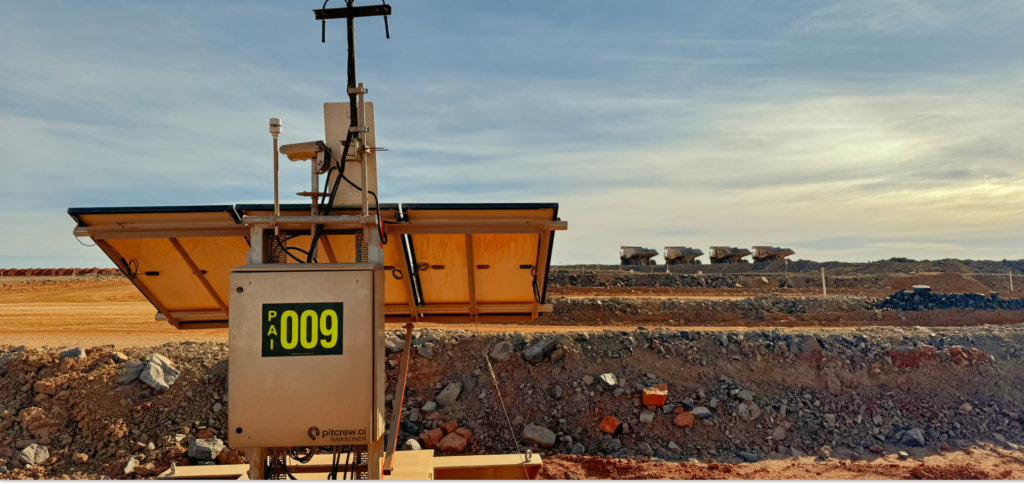
Pitcrew AIS is an infrastructure-based thermal inspection station that scans vehicles at normal operating speed using FLIR thermal imaging, computer vision and edge processing. Trucks pass through the inspection zone during normal haulage. Cameras capture the vehicle profile, including tyres, brakes, hubs, bearings and body. Edge processing classifies relevant anomalies in near real time, and configurable alerts feed Trigger Action Response Plans (TARPs) and maintenance triage.
Measurement quality depends on the camera and the geometry. Modern industrial thermal cameras deliver 640 × 480 resolution, thermal sensitivity below 0.05°C and 50 Hz capture. The practical constraint is the 5 × 5 pixel rule: a feature needs at least 25 pixels covering it for a reliable temperature reading. Below that, the camera averages the hot spot with cooler surrounding rubber and understates the peak, which is how genuine defects get missed by underspecified systems.
Deployment is trailer- or skid-mounted and relocatable, running on solar with battery backup or a grid connection, rated for -20°C to +55°C in IP66 enclosures. Typical deployment runs 4–8 weeks with zero fleet downtime. There are more than 42 deployments spanning iron ore, copper, gold and coal operations across Australia, North America, South America, Africa and Asia, with more than 672,000 tyre inspections completed in the 12 months to early 2026.
What are the limits of thermal imaging for mining equipment?
Thermal imaging is a strong condition-monitoring layer, but results depend on line of sight, surface condition, operating context and correct interpretation of temperature differentials. Pitcrew AIS delivers approximately 95% sensitivity for tread separations producing a thermal signature above the detection threshold, and the qualifiers around that figure are real.
Thermal imaging requires line of sight, so the system cannot see the far sidewall. Thick snow, mud or hauled material coating the tyre surface reduces or prevents a useful reading. Because it measures emitted heat rather than reflected light, thermal inspection continues to work in darkness, rain and typical dust. Direct sunlight adds roughly 3–8°C to apparent readings, which is why continuous reflected-temperature measurement and differential analysis matter more than absolute values. Frost and heavy contamination degrade signal quality outright.
Programme boundaries should be explicit. Thermal inspection does not replace pre-start checks, physical inspections or maintenance judgement. It is one layer within a multi-method tyre and asset reliability programme, and an anomaly should trigger assessment and a defined response rather than an automatic diagnosis of a specific failure mode.
How does thermal imaging complement tyre pressure monitoring systems?
TPMS monitors the inside of a tyre while thermal imaging monitors the outside, which makes the two technologies complementary rather than interchangeable. Tyre Pressure Monitoring Systems measure internal pressure and cavity temperature, identifying pressure loss and internal overheating. Pitcrew AIS measures external tread surface temperature and identifies structural thermal patterns, including tread damage, belt edge separation and tread separation signatures that pressure data alone won’t reveal.
Read together, the two data sets sharpen maintenance prioritisation. Correlating TPMS alerts with thermal trends, inspection history and tyre position lets planners schedule targeted inspections inside planned maintenance windows instead of reacting at the pit floor. With OTR tyres typically costing US$30,000–70,000 or more each depending on size, brand and supply contract, avoiding preventable casing loss carries obvious weight.
How can thermal imaging improve mine safety and operational continuity?
Continuous thermal inspection helps sites identify heat-related risks earlier, giving maintenance teams a window to intervene before a component failure, tyre event or fire escalates. In practice that means less exposure to emergency tyre, brake and wheel-end work, fewer reactive call-outs and unplanned equipment removals, and repairs scheduled rather than scrambled. Every pass also produces an objective, timestamped inspection record that supports maintenance decisions and incident review.
The fire data makes the case plainly. Brakes contribute 30% of non-impact haul truck fire initiations, tyres another 30%, and bearings 14%. That is 74% of initiations originating in component groups that generate detectable heat before they escalate.
Earlier detection only converts to better outcomes where TARP thresholds are defined, maintenance processes are ready to act, and flagged anomalies are investigated promptly. The technology supplies the signal; the site’s risk management process determines what happens next.
See it running on your fleet
If you want to know what heat your haul trucks are already generating, the fastest answer is a site assessment. Request a demo and we’ll walk through deployment options, alert thresholds and integration with your existing maintenance platform.
Frequently Asked Questions
Thermography is the use of thermal imaging to measure and interpret heat emitted from mining equipment, infrastructure and components. It identifies abnormal temperature patterns associated with friction, electrical resistance, structural damage, overheating and developing mechanical faults. Fixed-plant thermography typically involves handheld or mounted surveys of motors, conveyors and switchgear. Mobile equipment inspection is continuous and automated, scanning the haul fleet as it works.
Yes. When tyre layers separate, they move against each other under load and generate localised heat that a thermal camera reads at the tread surface. Pitcrew AIS achieves approximately 95% sensitivity for tread separations producing a thermal signature above the detection threshold. Two constraints apply: thermal imaging needs line of sight, so the far sidewall isn’t visible, and thick mud, snow or material on the tyre surface reduces reading quality.
No. TPMS measures internal pressure and cavity temperature; Pitcrew AIS monitors external tread surface temperature and structural thermal patterns. Neither substitutes for the other, and neither substitutes for pre-start checks. Both belong in a layered tyre management programme where the data sources cross-check one another.
Thermal cameras detect emitted heat rather than visible light, so they operate through darkness, rain and normal dusty conditions. Direct sunlight adds around 3–8°C to apparent readings, and frost, snow or heavy surface contamination reduces signal quality. Continuous monitoring, comparison against equivalent wheel positions and multi-pass trend data all help separate environmental effects from genuine faults.
Each pass captures the full vehicle profile: tyres, brake assemblies, wheel hubs, bearings, drivetrain-related areas and body. Current mining analysis focuses on tyre thermal signatures, while on-road configurations include brake, hub, bearing and sidewall asymmetry analysis. The system is fleet-agnostic and requires no vehicle fitment or modification.