

Autonomous Haulage
THERMAL TYRE HOTSPOT DETECTION FOR AUTONOMOUS HAULAGE
When you remove the driver, you remove the primary detection mechanism for thermal and mechanical failures on haul trucks. Pitcrew AIS replaces that lost safety layer with continuous, infrastructure-based thermal monitoring that inspects every autonomous truck on every pass, without stopping the vehicle or interrupting fleet coordination.
What inspection capability do you lose when you remove the driver?
Crewed haul trucks rely on three inspection layers that vanish with Autonomous Haulage System (AHS) operation.

Pre-start walk-arounds
Drivers visually check tyre condition two to three times per day at shift change.
Sensory detection during operation
Drivers feel vibration from a separating tread, smell burning rubber, and hear unusual noise.
Observation at stops
Drivers inspect tyres at fuel bays, maintenance pads, or load points.
How does Pitcrew AIS inspect autonomous haul trucks?
Pitcrew AIS inspects autonomous haul trucks from fixed roadside infrastructure as each truck passes at haul road speed. It does not require a stop, it does not add labour beside the truck, and it does not interrupt AHS dispatch, traffic sequencing, or intersection control. As an autonomous tyre inspection system, it operates entirely from the roadside with no on-vehicle hardware.
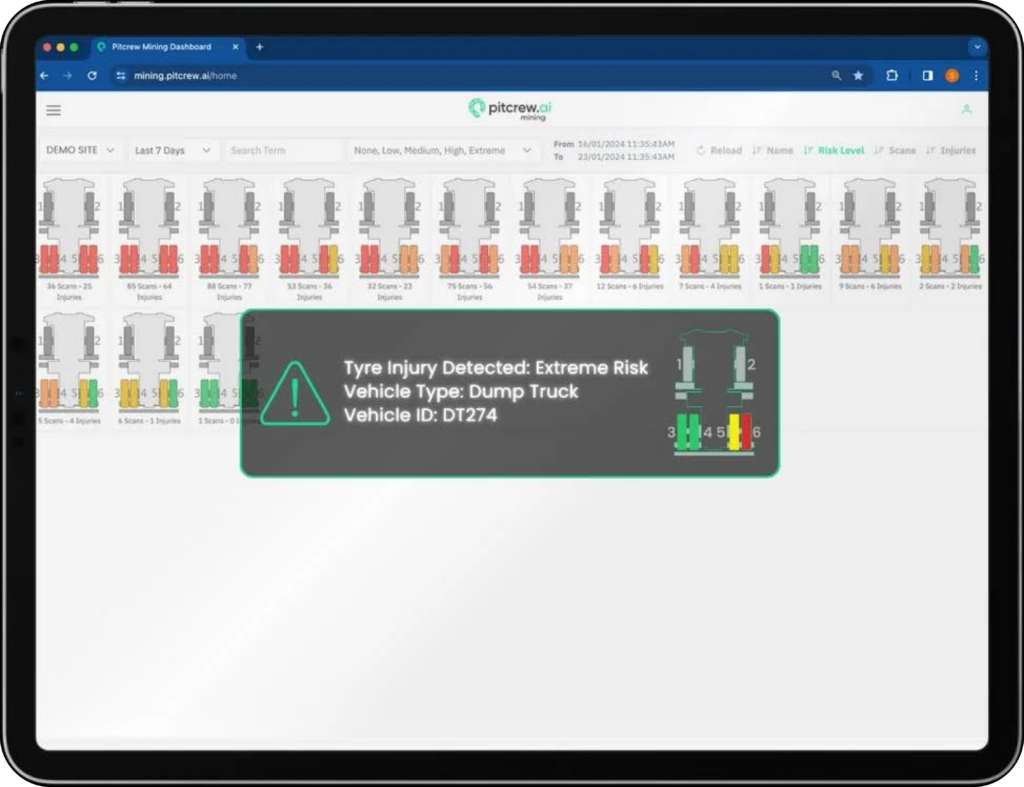
The system captures FLIR thermal imaging data across all visible tyre positions, brake assemblies, wheel hubs, and drivetrain components. Computer vision and AI process each scan on site within seconds, identifying thermal anomalies and flagging components that exceed configured alert thresholds. Alert thresholds are configurable per site to match local operating conditions and maintenance strategies. Critical faults trigger immediate alerts to maintenance teams. Developing issues are tracked over time through the Pitcrew AI customer dashboard, building a continuous thermal history for every tyre position across the fleet.
Inspection results are accessible through the customer dashboard and via REST API for integration with fleet management and maintenance systems. Configurable Trigger Action Response Plans (TARPs) automate alert routing based on severity.
Nothing is fitted to the vehicle. Any modification to an autonomous truck requires re-certification of the autonomous system. Pitcrew AIS avoids this entirely.
Trusted by





What does TPMS miss on autonomous mining truck inspection?
Tyre Pressure Monitoring Systems (TPMS) measure internal air pressure and cavity temperature. They detect pressure loss and internal overheating. TPMS cannot detect tread separations, belt edge separations, rock cuts developing into failures, or localised thermal anomalies within the tread compound. These failure modes produce measurable surface temperature differences well before internal pressure is affected. Internal temperature sensors cannot detect tyre fires that start on the outer casing. By the time TPMS registers an externally originating fire, the tyre may already be failing catastrophically.
| Capability | TPMS | Pitcrew AIS |
|---|---|---|
| Measurement method | Internal pressure and temperature sensors | External surface temperature via FLIR thermal cameras |
| Detects pressure loss | Yes | No |
| Detects tread/belt separation | No (until pressure affected) | Yes (thermal signature) |
| Detects external tyre fires | Late (lagging indicator) | Early (surface temperature) |
| Brake and bearing thermal anomalies | No | Yes |
| Vehicle fitment required | Sensors inside each tyre | None |
| AHS compatibility | Requires sensor management at each tyre change | No vehicle interaction |
| Maintenance overhead | Battery replacement, sensor reinstallation | None on vehicle |
TPMS covers the inside. Pitcrew AIS covers the outside. A mine running both covers pressure events and structural failures with no detection gap.
How large is the autonomous haulage fleet?
The global fleet of autonomous haul trucks reached 3,832 units as of July 2025, up 84% from 2,080 in July 2024 (GlobalData). Australia operates 1,024 autonomous trucks, the second-largest national fleet. The installed base is concentrated around two major platforms: Komatsu FrontRunner (700+ trucks across 23 sites in five countries since 2008) and Caterpillar MineStar Command for Hauling (500+ trucks across 18 sites).
AHS trucks operate an additional 700 hours per year compared to crewed trucks (Komatsu FrontRunner data), with 15 to 30% productivity improvements documented at mature sites (Caterpillar and tier-one Pilbara operator data). Tyre life improves by up to 35% due to more consistent driving patterns (Caterpillar five-year study). But improved wear life does not prevent externally caused damage, tread separations, or manufacturing defects. Those failure modes require external detection through autonomous haulage tyre monitoring.
The fleet is projected to approach 5,000 trucks by 2030. Every new AHS truck added is a truck that cannot be walked around, inspected by feel, or checked by a driver at shift change. The driverless haul truck tyre inspection gap grows with every deployment.
Our Technology
How does external inspection fit into AHS safety management?
External inspection belongs inside the mine’s safety management system because AHS removes human observation while increasing asset utilisation. In Western Australia, mine operators must prepare principal mining hazard management plans under the Work Health and Safety (Mines) Regulations 2022, including for roads and other areas where mobile plant operate. NSW, Queensland, and Chile have published similar frameworks. Based on published regulatory frameworks, no jurisdiction currently mandates automated tyre inspection for AHS operations, but all require risk-based hazard controls including condition monitoring.
An ultra-class Off-The-Road (OTR) tyre costs approximately US$50,000. Each truck carries six tyres, representing a US$300,000 investment. Undetected damage on a continuously operating AHS truck escalates quickly: catastrophic failure, extended downtime, haul road damage, and safety risk to maintenance personnel.
Autonomous haulage tyre temperature monitoring supports predictive maintenance by identifying abnormal heat before failure. It strengthens the evidentiary record that a site is actively monitoring high-consequence mobile assets. And it closes a known control gap created by driverless operation. Typical deployment takes two to four weeks from site survey to operational status.
Is your autonomous fleet protected?
If your haul trucks operate without drivers, your AHS tyre inspection process must operate without drivers too. Pitcrew AI has systems deployed at tier-one mining operations globally, with millions of component inspections completed in the past 12 months across Australia, North America, and South America. Contact the Pitcrew AI team to discuss integration with your AHS platform, deployment options, and expected outcomes.
Frequently Asked Questions
An autonomous haulage system (AHS) is a fleet management platform that controls haul trucks without an on-board driver. The system handles dispatch, routing, traffic management, and collision avoidance. Major platforms include Komatsu FrontRunner and Caterpillar MineStar Command for Hauling. Because AHS trucks operate without crew, all condition monitoring and inspection must be automated.
Autonomous mining uses driverless trucks, drills, and other equipment controlled by centralised software systems. Haul trucks receive instructions from an AHS controller that manages loading, hauling, dumping, and traffic sequencing across the pit. The trucks run continuously without shift changes, delivering higher utilisation. The trade-off is that every inspection function previously performed by a driver, including tyre checks, must be replaced by automated systems like Pitcrew AIS.
Pitcrew AIS is infrastructure-based and fleet-agnostic. It inspects any truck that passes the inspection zone, regardless of AHS platform. The system works with Caterpillar MineStar Command, Komatsu FrontRunner, and mixed-fleet operations without requiring integration into the AHS control system itself.
No. Nothing is fitted to the vehicle. Pitcrew AIS operates from roadside infrastructure and requires no sensors, tags, or hardware on the truck. This is important for AHS operations where any vehicle modification requires re-certification of the autonomous system.
TPMS monitors internal tyre pressure and cavity temperature. Pitcrew AIS monitors external surface temperature via FLIR thermal cameras. TPMS detects pressure loss. Pitcrew AIS detects tread separations, thermal anomalies, and external fire risks. Running both systems provides full-spectrum driverless haul truck tyre monitoring with no detection gap.
Autonomous haul trucks rely on GPS, LiDAR, radar, and cameras for navigation and obstacle detection. But these sensors are designed for vehicle control, not component health monitoring. AHS tyre inspection requires separate systems, such as TPMS for internal pressure and Pitcrew AIS for external thermal condition, to detect developing tyre and drivetrain failures that navigation sensors cannot identify.