

Mining
AI-POWERED MINING TYRE INSPECTION AND MONITORING
Pitcrew AIS (Autonomous Inspection System) detects tyre separations, brake anomalies, and bearing failures on mining haul trucks using FLIR thermal imaging and computer vision. The system scans all visible tyre positions on every pass at normal operating speed. No vehicle modifications. No production delays.
Systems deployed across tier-one mining operations in Australia, North America, South America, Africa and Asia, with millions of component inspections completed in the past 12 months.
Why Pitcrew Mining?

Real-Time Condition Monitoring
Our cutting-edge technology continuously monitors the condition of your mining transport equipment in real-time.
AI-Based Assessments
Leveraging advanced artificial intelligence, our system provides precise and reliable assessments of your equipment’s health.
Enhanced Safety
Safety is at the core of everything we do. Our autonomous monitoring technology significantly reduces the risk of accidents.
Increased Productivity
By minimising downtime and optimising equipment performance, our solutions help you achieve higher productivity levels.
Why do OTR tyre failures cost mining operations millions?
A single Off-The-Road (OTR) tyre failure on an ultra-class haul truck costs USD $150,000 to $500,000 in tyre replacement, equipment damage, and lost production. A major tyre fire (total loss of an ultra-class truck and haul road closure) can exceed USD $5 million. For a 50-truck fleet, the annual expected cost of tyre-related failures is $8 to $12 million.
An individual ultra-class OTR tyre (59/80R63) costs $80,000 to $150,000. According to industry research, approximately 90% of mining tyres never achieve their design life, with premature failures driven by heat-related degradation, road debris, and underinflation.
Manual walk-around inspections detect an estimated 10 to 20% of developing failures. Tyre Pressure Monitoring Systems (TPMS) detect pressure loss but cannot identify the tread separations and belt separations that precede most catastrophic failures. The thermal signature of a developing separation appears hours to days before internal pressure is affected. This detection gap is why traditional mining tyre inspection methods fall short, and why AI-driven thermal monitoring changes the equation.
How does mining tyre thermal monitoring work?
Pitcrew AIS is an infrastructure-based thermal inspection station positioned at a haul road inspection point. Trucks drive through at normal operating speed. All visible tyre positions are scanned automatically on every pass, with no vehicle stoppage, no driver action, and no modifications required.
-
01
Install
Trailer-mounted or skid-mounted at the roadside. No modifications to pit layout, haul roads, or vehicles.
-
02
Drive through
Haul trucks pass at normal speed. Two FLIR thermal cameras capture calibrated surface temperature data across all visible tyre positions, including outer and partial inner dual surfaces.
-
03
Detect
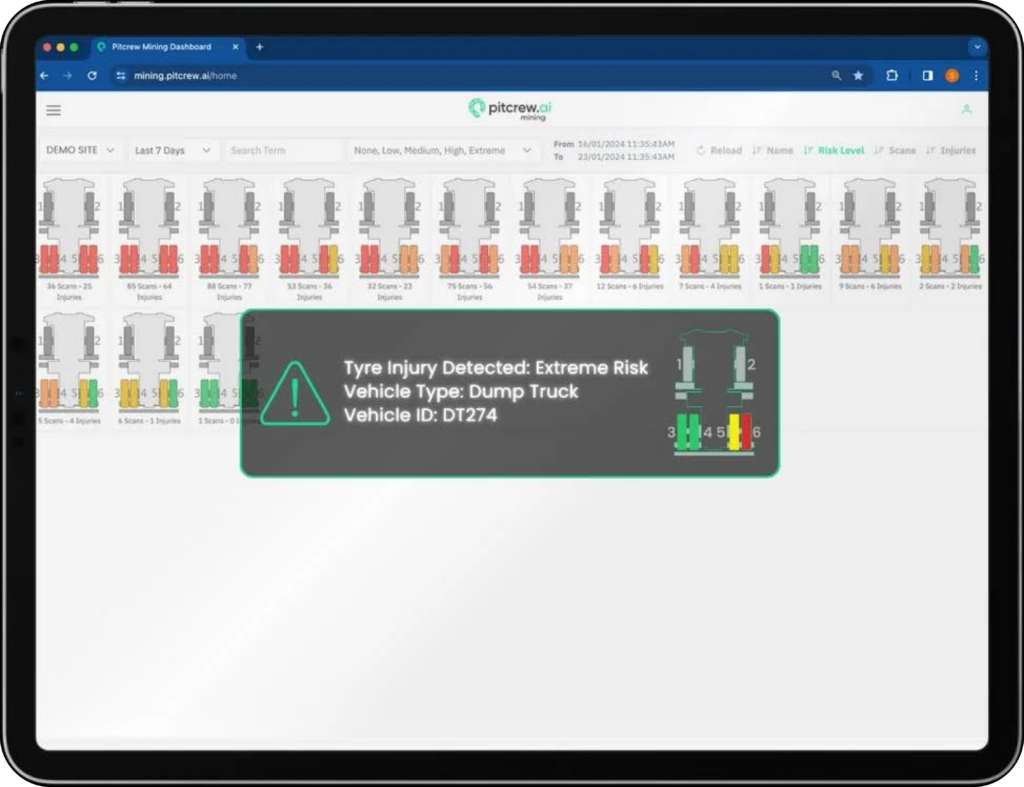
Computer vision on Nuvo industrial PCs processes each scan within minutes. Anomalies exceeding configured thresholds generate alerts through Trigger Action Response Plans (TARPs). Results transmit to the Pitcrew AI cloud platform on AWS for trending, reporting, and dashboard access.
What does Pitcrew AIS detect?
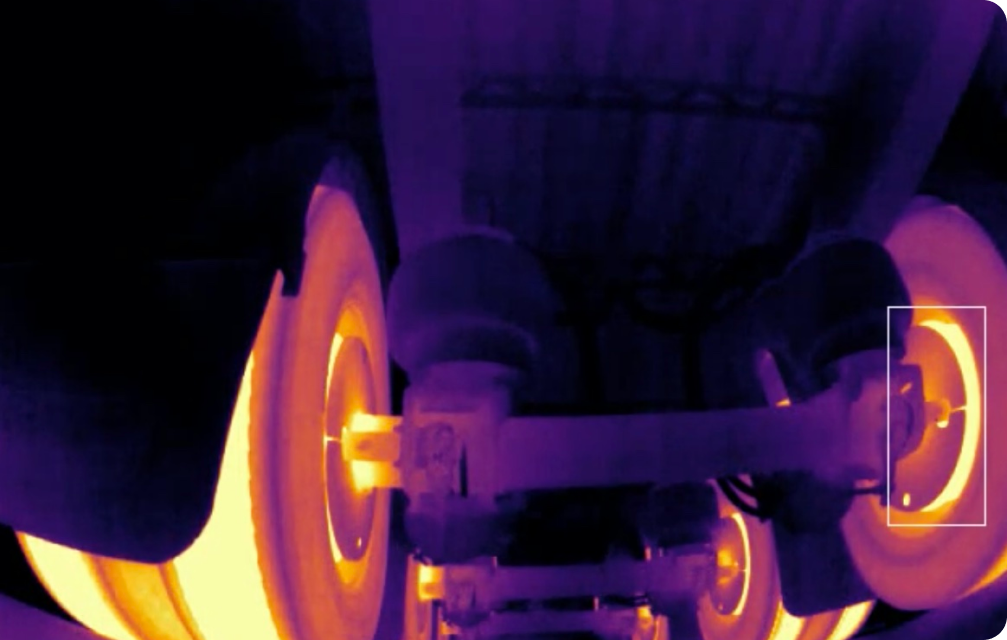
Pitcrew AIS detects tread separations, developing belt separations, brake overheating, bearing failures, and underinflation indicators via calibrated external surface temperature measurement. A tread separation produces a localised hot spot 20 to 50+ degrees Celsius above the surrounding tyre surface. These signatures are detectable before the defect is visible externally or affects internal pressure.
Normal OTR tyre surface temperature is 60 to 80 degrees Celsius during operation. A developing separation presents 20 to 50 degrees Celsius or more above the surrounding tread. The system achieves approximately 95% sensitivity for tread separations producing a thermal signature above the detection threshold (validated across operational deployments). Configurable alert thresholds and multi-pass trending reduce false positives by distinguishing persistent anomalies from transient readings caused by braking or sun exposure.
Our Technology
How does Pitcrew AIS compare to TPMS?
TPMS measures internal tyre pressure and cavity temperature. Pitcrew AIS measures external tread surface temperature via FLIR thermal cameras. They detect different failure modes and are complementary.
| Capability | TPMS | Pitcrew AIS |
|---|---|---|
| Measurement method | Internal pressure and temperature sensors | External surface temperature via FLIR thermal imaging |
| Detects pressure loss | Yes | No (detects thermal indicators of underinflation) |
| Detects tread/belt separation | No (until pressure is affected) | Yes (thermal signature appears hours to days earlier) |
| Detection lead time for separation | Late (pressure change is a lagging indicator) | Early (thermal anomaly is the leading indicator) |
| Vehicle fitment | Sensors fitted inside each tyre | None. Infrastructure-based. |
| AHS compatibility | Requires sensor management at every tyre change | No vehicle interaction required |
| Fleet coverage | Fitted tyres only | Every vehicle per pass |
A mine running both TPMS and Pitcrew AIS covers pressure events and structural failures with no detection gap. Together, they deliver the most complete tyre condition monitoring system mining operations can achieve.
Trusted by





What results have operations achieved with the Pitcrew mining tyre monitoring system?
Operators using Pitcrew AIS have identified tread separations, confirmed on post-removal analysis, that manual inspections and TPMS missed. Early detection shifts tyre removals from unplanned roadside events to scheduled workshop maintenance, reducing safety risk and secondary damage to rims and components.
Kal Tire, a global mining tyre service provider, resells the platform as “TireSight” across their international operations. Inspection results are accessible via REST API and CSV export for integration with fleet management and CMMS platforms.
| Metric | Value |
|---|---|
| Active systems globally | Dozens across Australia, North America, South America, Africa and Asia |
| Component inspections (past 12 months) | Millions |
| Operating regions | Australia, North America, South America |
| Operating conditions | Tropical, arid, and cold climates. Sea level to 4,500 metres altitude. |
| Customer profile | Tier-one global mining operators |
| Channel partner | Kal Tire (resells as "TireSight") |
Is Pitcrew AIS compatible with driverless mining trucks (AHS)?
Autonomous haul trucks cannot be stopped for manual inspection without disrupting traffic management, and there is no driver to notice tyre odour, vibration, or brake fade. The global autonomous fleet reached 3,832 trucks in mid-2025, growing 83% year on year. Infrastructure-based inspection is the only scalable approach for these fleets.
Pitcrew AIS inspects autonomous trucks on every pass at normal operating speed with zero human intervention. The system is fleet-agnostic and works with Caterpillar, Komatsu, Hitachi, and Liebherr platforms, both crewed and autonomous. No vehicle fitment or integration with the autonomous traffic management system is required.
How is Pitcrew AIS deployed at a mine site?
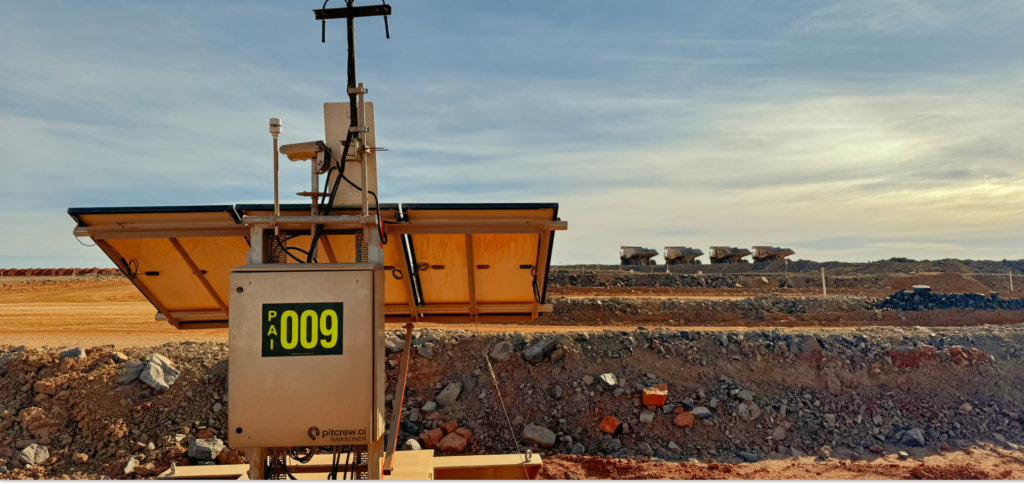
Pitcrew AIS is a standalone unit requiring minimal site preparation. Trailer-mounted units relocate between haul roads, pit exits, or dump approaches as priorities change. Skid-mounted units bolt to concrete pads for permanent deployment. Solar-powered with battery backup. No mains power connection required.
| Specification | Detail |
|---|---|
| Mounting | Trailer-mounted (relocatable) or skid-mounted (permanent) |
| Power | Solar with battery backup |
| Environmental rating | IP66 |
| Operating temperature | -20 to +55 degrees Celsius ambient |
| Connectivity | Cellular (4G/LTE), site Wi-Fi, or Ethernet |
| Vehicle fitment | None |
| Tyre sizes supported | 27.00R49 through 59/80R63 |
| On-site operator | Not required |
Ready to evaluate haul truck tyre inspection with Pitcrew AIS?
See how autonomous thermal inspection works at your site. The Pitcrew AI mining truck tyre maintenance team will assess deployment options, integration requirements, and expected outcomes for your fleet.
Frequently Asked Questions
Pitcrew AIS and TPMS detect different failure modes, so one doesn’t directly replace the other. TPMS tracks internal pressure and cavity temperature, while Pitcrew AIS detects structural failures like tread and belt separations through external thermal signatures. Many sites run both systems together to close every detection gap, but for operations where TPMS sensor management is impractical (especially autonomous fleets), Pitcrew AIS provides the higher-value detection layer without any in-tyre hardware.
Every truck is scanned on every pass through the inspection point. On a typical haul cycle, that means each truck gets inspected multiple times per shift. This frequency builds a thermal trend history for each tyre position, making it easier to distinguish a developing separation from a one-off heat spike caused by braking or ambient conditions. The multi-pass data is what drives the system’s approximately 95% sensitivity for tread separations producing a thermal signature above the detection threshold.
No. The system is designed to operate unattended. FLIR cameras are factory-calibrated, and the unit runs on solar power with battery backup, so there’s no daily operator involvement. Software updates and remote diagnostics are managed through the Pitcrew AI cloud platform. Site teams don’t need to perform routine calibration, sensor swaps, or physical maintenance beyond occasional cleaning of camera lenses in dusty conditions.