

What Is Thermal Tyre Inspection and How Does It Work?
TL;DR
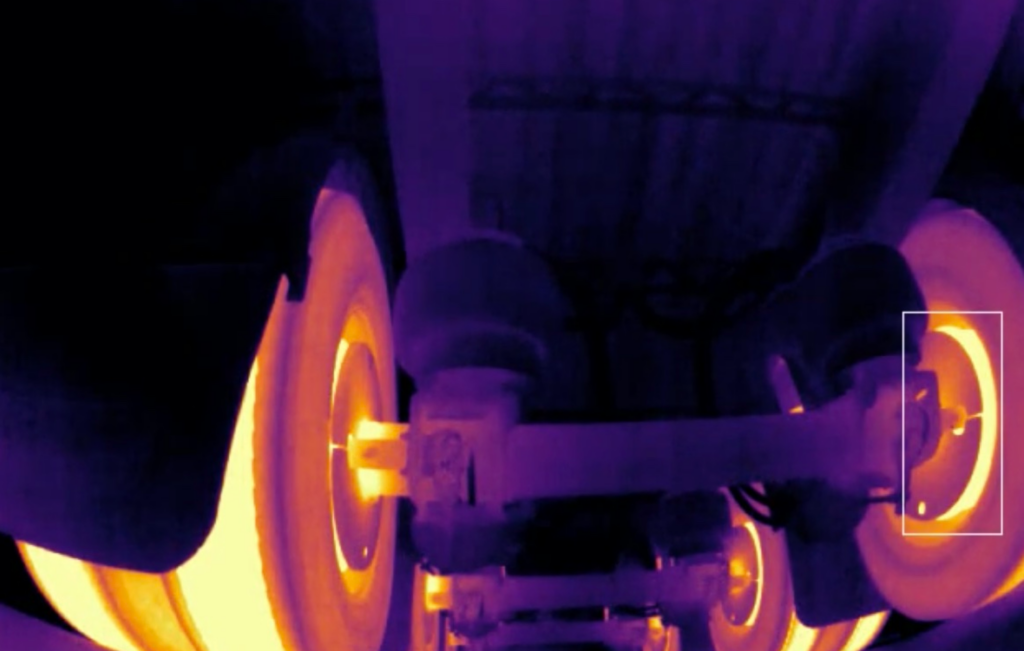
Failing Off-The-Road (OTR) tyres generate measurable heat signatures days before catastrophic failure. FLIR thermal cameras detect these signatures externally by mapping surface temperature pixel-by-pixel using long-wave infrared (LWIR) sensors. Internal faults such as belt separations create localised hot spots 20 to 50 degrees C above the surrounding tread. Tyre Pressure Monitoring Systems (TPMS) miss these heat-based faults because up to 180mm of rubber and steel belt layers insulate the tread from the internal air chamber. Pitcrew AIS scans every tyre on every pass, providing continuous thermal tyre monitoring across a fleet’s operating life.
How Does Thermal Tyre Inspection Detect Developing Faults?
Thermal signatures precede visible damage by hours to days. A tyre with an active belt separation looks identical to a healthy tyre under visual inspection, but its surface temperature tells a different story. Thermal tyre inspection detects developing faults by mapping surface temperature across the entire tread and sidewall using LWIR cameras operating in the thermal infrared rangerange. Internal faults generate friction and heat that conducts to the surface, creating temperature anomalies visible to FLIR thermal cameras even when the tyre looks normal to the eye.
When a belt separation begins inside an OTR tyre, the separated layers rub against each other under load. This internal friction generates localised heat that conducts outward through the rubber to the tread surface, appearing as a hot spot or circumferential hot streak. The thermal camera converts raw infrared radiation into temperature readings using factory calibration against blackbody reference sources. Rubber has high emissivity (approximately 0.95), so nearly all detected radiation is genuine emission from the tyre rather than environmental reflection.
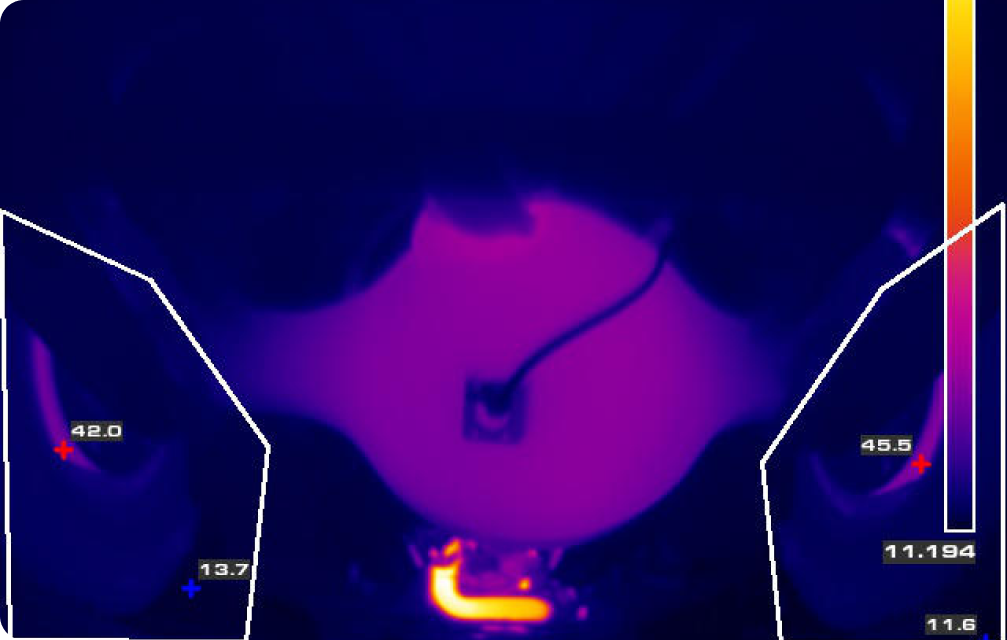
A developing separation runs 20 to 50 degrees C above the surrounding tread on the same tyre. As the separation progresses, the thermal anomaly grows in both temperature and area. Multi-pass trending and cross-axle comparison pick up small, persistent differentials well before they reach alert thresholds, catching faults at their earliest detectable stage. The system analyses temperature differentials across the tyre surface rather than absolute temperature, making detection reliable regardless of ambient conditions.
What Thermal Patterns Indicate Specific Tyre Faults?
Thermal imaging reveals several failure modes that are invisible to visual inspection, including belt separations, brake drag, bearing failures, and sealed injuries. Each fault type produces a distinctive thermal signature that trained analysts and machine learning models can distinguish.
Belt and tread separations. The most critical fault. A localised hot spot where the casing is delaminating. The separation traps heat beneath the rubber surface, and that heat conducts outward. On a thermal image, a distinct bright zone appears on the tyre face at temperatures significantly higher than the surrounding rubber.
Brake drag. Extreme heat at the wheel assembly, visible at the brake rotor, caliper, or drum. A truck with one brake dragging shows that wheel significantly hotter than the others. The thermal contrast is unmistakable.
Bearing failures. A failing bearing generates heat at the hub, which conducts through the wheel into the tyre and appears as a hot spot at the wheel end. Thermal imaging provides an independent check that complements bearing temperature sensors.
Sealed versus venting injuries. A sealed injury (where rubber closes around the damage) traps heat beneath the surface. Internal temperature can keep rising without external cooling, creating a fire risk. A venting injury releases heat to the air. Both require action, but sealed injuries are more urgent because the thermal build-up is hidden.
Why Do Failing OTR Tyres Generate Heat Before They Fail?
Failing tyres generate heat because internal structural damage creates friction zones that convert mechanical energy into thermal energy with every wheel rotation. A damaged tyre pumps progressively more heat into the fault zone, and the process accelerates until the casing fails catastrophically.
The primary heat generation mechanism in a failing OTR tyre is belt separation. This begins at the shoulder area where flexion and heat concentration are greatest. Under normal operation, an OTR haul truck tyre runs at surface temperatures between 60 and 80 degrees C. When the belts begin to separate, internal rubbing and flexion in the damaged zone push local temperatures above 80 degrees C. A localised zone persistently running 20 or more degrees above the surrounding tread indicates developing structural failure.
Tyre manufacturers rate each tyre for Tonne-Kilometres Per Hour (TKPH), which is a thermal capacity limit. Exceeding TKPH causes internal heat build-up with zero external warning signs visible to the human eye. The temperature in the affected zone can reach 20-50 degrees C above normal operating range. Once the fault zone reaches thermal runaway, the failure progresses rapidly toward blowout or fire. The entire process from initiation to catastrophic failure can take days to weeks, creating a viable window for thermal detection and intervention.
Why Does External Thermal Detection Catch Faults That TPMS Misses?
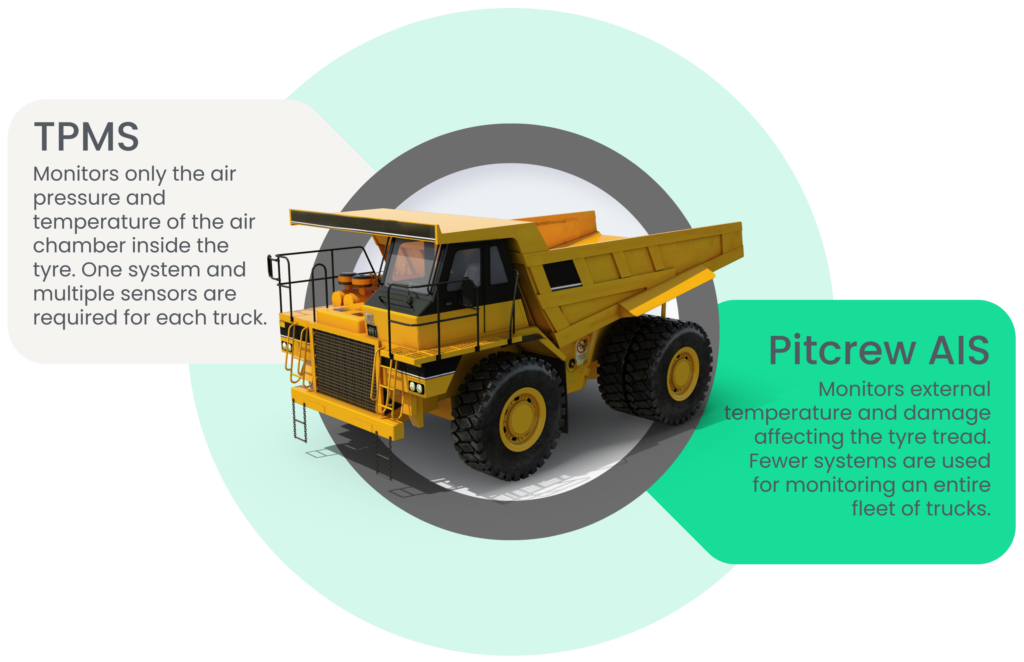
External thermal detection catches faults that TPMS misses because belt separations and tread delaminations generate heat in the tread and belt layers, not in the air chamber where TPMS sensors sit. On ultra-class OTR tyres, up to 180mm of rubber, steel belts, and casing material separates the internal chamber from the outer tread surface, creating a significant insulating barrier.
Rubber has a thermal conductivity of just 0.15 W/m K, roughly 300 times less conductive than steel. A belt separation generating significant heat in the tread area can exist for days before the internal air chamber temperature rises enough for a TPMS sensor to register an alert. In many cases, the tyre fails structurally before the pressure or temperature change reaches the TPMS threshold. This insulating effect is why pressure-based monitoring alone cannot provide early warning of heat-driven failure modes.
TPMS excels at detecting underinflation and slow pressure leaks. External thermal imaging excels at detecting structural failures, belt separations, and TKPH exceedance. The two technologies detect fundamentally different failure modes. A tyre can be at correct pressure and still have an active belt separation that will destroy it within days. Learn more about how these technologies compare in TPMS vs External Thermal Monitoring: What Each System Detects.
How Do Camera Resolution and Distance Affect Detection?
A thermal camera’s ability to measure a hot spot accurately depends on how many pixels cover the target area. The industry working standard requires approximately 5×5 pixels covering the smallest feature to be detected. Below that threshold, the hot spot blends with cooler surrounding rubber and the reading understates the true temperature.
At any given distance, a higher-resolution camera delivers more accurate measurements. A 640×480 sensor covers a 2cm hot spot with 9-12 pixels at 3 metres, producing a stable reading. A 320×240 sensor at the same distance covers the same spot with only 3-4 pixels, introducing noise. If the hot spot is physically smaller than the camera’s instantaneous field of view (IFOV) at the measurement distance, the reading will average the hot spot with its surroundings. Fixed-installation systems eliminate this variable by using a known, consistent measurement distance for every pass.
What Environmental Factors Affect Thermal Readings?
Reflected temperature, ambient conditions, vehicle speed, and surface contamination all influence thermal measurement accuracy. Automated systems compensate for these factors using on-site environmental sensors, while handheld operators must account for them manually.
-
01
Reflected temperature
Even at 0.95 emissivity, 5% of the detected signal comes from environmental reflection. Direct sunlight striking the tyre surface can add 3-8 degrees C to the apparent reading. Proximity to hot surfaces (engine exhaust, recently operated brakes, hot haul roads) introduces similar errors. Automated systems measure reflected temperature continuously and compensate automatically.
-
02
Ambient temperature and humidity
Infrared radiation is partially absorbed by the atmosphere, particularly by water vapour. At typical inspection distances of 1-20 metres, the effect is small in arid conditions but more significant in humid tropical climates.
-
03
Vehicle speed and operating history
A truck that just descended a long ramp has a different thermal signature than one parked for an hour. High-speed passes (above 20 km/h) limit the camera’s integration time and can reduce measurement accuracy. Inspection systems are typically positioned where trucks naturally slow down.
-
04
Surface contamination
Dust, mud, and water on tyre surfaces reduce effective emissivity and can partially mask thermal signatures. In cold conditions, frost or snow can hide a hot injury beneath. Measuring relative temperature differences across the tyre surface reduces the impact of uniform contamination.
How Much Warning Does Thermal Detection Provide?
Thermal imaging can detect tyre delamination 24-48 hours before catastrophic failure, based on published research and field deployment data from Teledyne FLIR. In many cases, the window is longer because belt separation progresses over days to weeks before reaching the critical failure stage.
The detection lead time depends on inspection frequency. A manual thermal scan might catch a fault once per shift or once per day. An autonomous system like the Pitcrew Autonomous Inspection System scans every tyre on every pass, which means a developing fault is tracked across multiple inspections. Each scan builds a thermal history that shows whether the anomaly is growing, stable, or resolved. This sequential tracking enables growth-rate prediction rather than single-point-in-time assessment.
Approximately 90% of OTR tyres never achieve their design life, according to industry research. Early detection of developing failures extends the usable life of undamaged tyres by preventing cascading damage. It also preserves tyre casings for retreading, which reduces per-tyre costs by up to 31%. Understanding what tyre failures cost mining fleets is the foundation of an effective thermal tyre monitoring programme.
How Do Manual and Automated Thermal Tyre Inspection Compare?
Manual thermal inspection relies on a technician with a handheld infrared camera walking around a parked truck. Each operator brings their own technique, camera settings, and interpretation. One technician might stand 2 metres from the tyre while another stands 5 metres. One sets emissivity to 0.95, another leaves it at the factory default. The same truck inspected by two technicians on different days can produce different conclusions. Manual inspection is also limited by frequency. With 500 trucks in a fleet, manual scans happen weekly or monthly at best, leaving long gaps where failures develop undetected.
Automated systems place thermal cameras at fixed infrastructure beside the haul road. Every truck passes through the same location, so cameras are always at the same distance with the same angles. Parameters are set once during deployment and adjusted seasonally. Environmental factors (atmospheric temperature, humidity, reflected temperature) are measured by on-site sensors and applied automatically. This consistency is the key advantage. Instead of trying to achieve absolute accuracy, the system learns the normal thermal profile for each tyre position on each vehicle and flags deviations from baseline. A tyre suddenly 10 degrees C above its historical average triggers a review, regardless of ambient conditions.
Where Does Thermal Imaging Fit in the Safety Hierarchy?
Thermal imaging is not a replacement for existing tyre management systems. It is an additional independent layer of detection. TPMS monitors pressure. Visual inspection catches cuts, bulges, and obvious surface damage. Brake temperature sensors detect brake drag. Each system has blind spots. TPMS does not detect slow internal separations. Visual inspection misses damage inside the casing. Brake sensors do not see tyre defects.
Thermal imaging fills those gaps. A heat separation invisible to TPMS and visual inspection is obvious on a thermal image. Multiple overlapping controls, each covering different failure modes, provide the most complete safety net. This layered approach is especially critical for autonomous haulage system (AHS) fleets, where there is no driver to notice visual signs of damage, smell burning rubber, or feel changes in ride quality. Infrastructure-based thermal inspection provides the continuous monitoring that autonomous operations require.
What Does Thermal Detection Look Like in Practice?
The Pitcrew Autonomous Inspection System (AIS) from Pitcrew AI is a roadside thermal inspection station deployed at mining operations worldwide. The system uses two FLIR thermal cameras on a trailer-mounted or skid-mounted unit positioned beside the haul road. As trucks pass at normal operating speed, the system captures thermal images of every tyre on every wheel position without requiring the vehicle to stop.
The computer vision processing unit analyses each thermal image, flagging anomalies for maintenance review. Pitcrew AIS has completed millions of autonomous component inspections across tier-one mining operations globally, including sites operated by leading global mining operators. The system works on crewed trucks and autonomous haulage system (AHS) trucks equally. Field data confirms approximately 95% sensitivity for tread separations producing a thermal signature above the detection threshold. Thick snow, mud or hauled material coating the tyre surface reduces or prevents a useful reading.
Frequently Asked Questions
Field deployment data shows approximately 95% sensitivity for tread separations producing a thermal signature above the detection threshold. Thick snow, mud or hauled material coating the tyre surface reduces or prevents a useful reading. Rubber’s high emissivity (approximately 0.95) means thermal cameras read tyre surface temperatures with minimal measurement error compared to low-emissivity materials like polished metal.
The cost of a thermal tyre inspection depends on whether it is delivered manually or through an automated system. Manual handheld scans carry labour and downtime costs each time a truck is stopped, while an automated system like Pitcrew AIS inspects every tyre on every pass without stopping the vehicle, spreading the cost across continuous monitoring rather than per-inspection charges. For pricing tailored to fleet size, request a demo.
An OTR haul truck tyre typically runs at surface temperatures between 60 and 80 degrees C under normal operation. A localised zone persistently running 20 or more degrees above the surrounding tread, or above 80 degrees C, signals developing structural failure. Each tyre also carries a TKPH rating that sets its thermal capacity limit, and exceeding it causes internal heat build-up that can lead to blowout or fire.
LWIR thermal cameras detect emitted heat, not reflected light, so they operate in bright sunlight, darkness, dust, and rain. Direct sunlight can add 3-8 degrees C to apparent readings, but automated systems compensate by measuring reflected temperature continuously. The system measures relative temperature differences across the tyre surface rather than absolute temperature, which reduces the impact of ambient variation. Field data from Pitcrew AIS deployments confirms reliable detection across extreme heat, cold, and heavy dust.
LWIR thermal cameras detect emitted heat, not reflected light, so they operate in bright sunlight, darkness, dust, and rain. Direct sunlight can add 3-8 degrees C to apparent readings, but automated systems compensate by measuring reflected temperature continuously. The system measures relative temperature differences across the tyre surface rather than absolute temperature, which reduces the impact of ambient variation. Field data from Pitcrew AIS deployments confirms reliable detection across extreme heat, cold, and heavy dust.
No. Thermal imaging and TPMS detect different failure modes. TPMS monitors internal air chamber pressure and temperature, detecting underinflation and slow leaks. Thermal imaging detects structural failures, belt separations, and heat-based anomalies in the tread and belt layers. Pitcrew AIS complements TPMS by covering the failure modes that pressure-based sensors cannot detect until the damage is advanced.
Autonomous haulage system (AHS) trucks operate without a driver who might notice visual signs of tyre damage, smell burning rubber, or feel changes in ride quality. Roadside thermal inspection provides continuous tyre condition monitoring that autonomous operations require. Nothing is fitted to the vehicle, so the system works with any truck from any manufacturer without disrupting autonomous traffic management.
Rubber has an emissivity of approximately 0.95, which means 95% of detected radiation is genuine emission from the tyre surface. Most thermal imaging software defaults to this range, but operators should verify rather than assume. If emissivity is set incorrectly, temperature readings will be systematically wrong. Setting it too low overstates temperatures. Setting it too high understates them. For handheld inspections, confirm the setting is between 0.93 and 0.97 for rubber surfaces.