

How AI Is Transforming Mining Equipment Performance
TL;DR
Heat is the earliest honest signal a heavy vehicle gives before something fails. A belt separation inside an off-the-road tyre casing generates friction heat long before the tread shows a bulge, and a dragging brake runs hot long before smoke appears. Thermal imaging reads that signal on every pass.
Key Takeaways
- Artificial intelligence (AI) improves mining equipment performance when it converts continuous condition data into timely, auditable maintenance actions rather than standalone alerts.
- AI in mining spans driver monitoring, predictive maintenance, autonomous haulage, automated inspection and route optimisation, yet automated mechanical inspection remains the least commercially mature category despite strong validation evidence.
- For tyres and wheel-end components, thermal condition analytics identifies external heat patterns associated with developing structural damage that conventional manual checks may miss.
- The Pitcrew Autonomous Inspection System (AIS) processes thermal imagery at the edge, then applies multi-pass analytics and maintenance workflows to support intervention before a developing issue escalates.
- A credible AI condition analytics programme complements existing inspection methods, including Tyre Pressure Monitoring Systems (TPMS), pre-start checks and planned maintenance, rather than replacing them.
What Does AI Mean for Mining Equipment Performance?
AI improves mining equipment performance by turning high-volume condition, operational and inspection data into earlier and better-prioritised maintenance decisions. The value sits in the decision, not the algorithm.
High-utilisation haul fleets work in abrasive, remote and variable conditions, and the financial consequence of an unplanned stop is severe. For iron ore operations, lost production is commonly valued at US$18,000 to US$32,000 per truck-hour. A single Off-The-Road (OTR) tyre costs roughly US$30,000 to US$70,000 or more, depending on size, brand and contract structure. Against those numbers, a failure detected a shift early pays for a lot of analytics.
Condition analytics using AI means applying machine learning, computer vision and trend analysis to identify degradation patterns, instead of relying only on fixed alarm thresholds or a scheduled inspection interval. It is decision support for reliability, maintenance and safety teams. It does not replace engineering judgement.
Adoption across the five AI categories is uneven. Autonomous haulage and predictive maintenance attract most of the capital, while automated mechanical inspection carries arguably the strongest validation evidence and the least commercial maturity. That gap is where practical gains are still available. Only 27% of heavy vehicle fleets currently use predictive maintenance, though 65% plan to adopt AI-powered maintenance by the end of 2026. Deloitte research associates AI-driven predictive maintenance across industrial fleets with a 25% productivity gain, a 70% reduction in breakdowns and a 25% reduction in maintenance costs. Treat those as broad industrial benchmarks, not site-specific guarantees.
What Can AI Condition Analytics Measure on Mobile Mining Equipment?
Condition analytics measures and interprets changes in thermal, visual, mechanical and operating-condition data to flag anomalies that warrant human review. The useful data categories on a haul fleet include thermal signatures from tyres, brakes, hubs and bearings; internal pressure and cavity temperature from TPMS; vibration, oil analysis and drivetrain telemetry where fitted; and context such as payload, haul route, ambient temperature and maintenance history.
The tyre-monitoring distinction matters. TPMS monitors the inside of the tyre. Pitcrew AIS monitors the outside, reading tread surface temperature and thermal patterns associated with structural damage. The two are complementary, and neither removes the need for pre-start checks or a broader tyre management programme.
Thermal indicators that typically justify action include localised tread temperature anomalies, developing tread or belt separation signatures, abnormal wheel-end heat linked to brakes, hubs or bearings, and repeat anomalies that worsen across successive passes. Pitcrew AIS delivers approximately 95% sensitivity for tread separations producing a thermal signature above the detection threshold. Detection depends on line of sight, so the far sidewall is not inspected, and thick snow, mud or material on the tyre surface reduces visibility.
Independent research separates thermal inspection from generic AI marketing. A Kentucky Transportation Center study found vehicles flagged by thermal imaging had a 59% out-of-service rate, against 19% for conventional inspection. NURail Center work at Michigan Technological University demonstrated 98% detection of defective railway wheels from thermal imagery with zero false alarms on normal wheels. University of Illinois research indicates that fusing thermal and visible-spectrum imagery lifts defect-detection reliability. Those results support the method. Performance still has to be proven in your own operating conditions.
How Does Mining Equipment Condition Analytics AI Work End to End?
Effective condition analytics joins reliable data capture, fast edge inference, cloud-based trend analysis and a defined maintenance response.
| Stage | Function | Maintenance outcome |
|---|---|---|
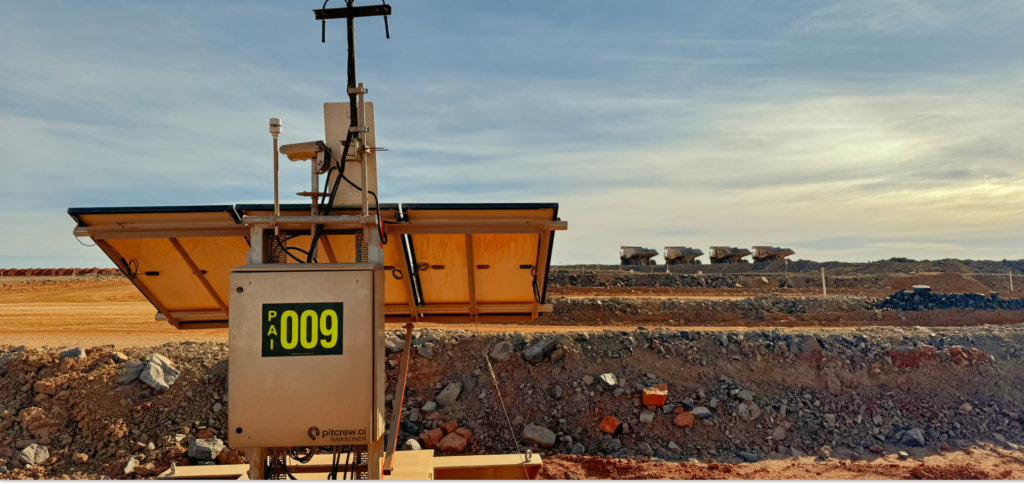
| Roadside capture | FLIR thermal cameras image tyres and wheel ends as trucks pass at normal speed | Every pass inspected without stopping production |
| Edge inference | Nuvo industrial computers run Open Neural Network Exchange (ONNX) models trained on an extensive annotated thermal image library | Component areas located, anomalies classified for severity |
| Data transfer | A 5 to 50 kilobyte metadata packet is sent to the Amazon Web Services (AWS) cloud platform | Works on constrained site bandwidth |
| Trend analysis | Multi-pass trending, individual damage identifiers and growth-trajectory projections | Estimated window for intervention |
| Response | Trigger Action Response Plans (TARPs) route findings to a person, dashboard or work order | Accountable, closed-loop action |
Edge processing matters at remote sites for two reasons. Inference runs locally in roughly 15 to 50 milliseconds, where cloud-only processing adds around 50 to 500-plus milliseconds. And the station keeps working when connectivity drops. The honest trade-off is higher upfront hardware spend for that local speed and independence.
Results reach the customer dashboard, a REST application programming interface (API), webhooks and data exports. Connecting those findings to fleet management, maintenance planning and work-order systems is what stops an alert becoming a screenshot nobody actions.
What Should Maintenance Teams Ask When Evaluating an AI Inspection Vendor?
Judge vendors on measurable detection performance, stated operating constraints, workflow integration and evidence from conditions comparable to your site. A short evaluation checklist:
- Which failure modes does the system detect, and which does it explicitly not detect?
- Is sensitivity defined against a specific failure class, severity threshold and inspection condition, or quoted as a bare percentage?
- Are detection claims backed by independent research, field validation or a published test method?
- How are false positives, missed detections and uncertain findings measured and managed over time?
- Does each finding produce an auditable record with timestamp, vehicle identification, component location, imagery and action history?
- Can thresholds be configured to your TARPs and risk tolerances?
- Does it integrate with your Computerised Maintenance Management System (CMMS) and fleet management platform, or create another silo?
Then ask the mining-specific hardening questions that generic providers rarely answer well. How are lenses kept usable in dust and mud? How is calibration held when vibration shifts a mount or site traffic patterns change? Can the system read equatorial sun and full darkness within one shift? How does it compensate for ambient conditions ranging from -40°C in northern Canada to above 45°C in the Pilbara? Moderate-resolution infrared can deliver stronger predictive accuracy in warmer conditions, but the algorithms need seasonal compensation to stay reliable as ambient temperatures swing.
For context on what deployment credentials look like, Pitcrew AIS operates fleet-agnostically across major haul truck platforms and tyre sizes from 27.00R49 through to 59/80R63, in IP66 enclosures, solar-powered with battery backup, trailer- or skid-mounted and relocatable. Typical deployment runs 4 to 8 weeks with zero fleet downtime, drawing on more than 42 deployments across Australia, North America, South America, Africa and Asia in iron ore, copper, gold and coal operations. No credible vendor should present thermal analytics as a silver bullet, or claim it replaces manual inspection, TPMS or engineering review.
How Does AI Improve Maintenance Decisions Without Creating More Alerts?
Analytics earns its place by prioritising repeated, worsening and operationally relevant anomalies instead of escalating every deviation. A single hot reading might reflect payload, a long downhill brake application, haul-road condition or ambient temperature. Multi-pass analytics adds persistence, location, severity and growth rate to that observation, and individual damage identifiers let a team track one developing issue instead of chasing five disconnected notifications.
The decision model to aim for is straightforward: detect the anomaly, confirm it with repeat evidence and operating context, classify severity against the site risk framework, assign a TARP action from monitor through to removal from service, then record the outcome so thresholds and models improve.
The performance payoff shows up as work scheduled into planned windows, intervention before secondary damage or a catastrophic tyre failure, better tyre-life management with fewer premature removals, and objective, audit-ready records for reliability and safety review. Market investment reflects the interest: AI vehicle inspection was valued at US$465.3 million in 2024 and is projected to reach US$2.64 billion by 2034, a 19.6% compound annual growth rate. Growth signals capital, not proof that any given product is mine-ready.
What Are the Limits of AI-Driven Mining Equipment Inspection?
Thermal inspection detects heat-related patterns, and not every defect produces a visible thermal signature. Line of sight means the far sidewall is not captured on a single pass. Snow, mud and packed material obscure thermal evidence. Output quality depends on camera placement, component identification, environmental calibration and the quality of labelled training data.
Governance carries equal weight. High-consequence decisions still need human review and site-specific TARP design, with named ownership for responding to findings, verifying repairs and closing work orders. Model performance should be reviewed against confirmed maintenance outcomes rather than accepted as fixed.
Pre-start checks, manual inspections, TPMS, oil analysis, vibration monitoring and thermal inspection each catch different failure pathways. Pitcrew AIS adds continuous external monitoring to that stack with no vehicle modifications and no production delays.
See condition analytics working on your fleet
If you are assessing AI inspection for a haul fleet, the fastest way to test the claims is against your own trucks, tyre sizes and ambient conditions. Request a demonstration or site assessment to review detection performance, integration options and deployment requirements with the Pitcrew AI engineering team.
Frequently Asked Questions About AI Mining Equipment Analytics
No. Pitcrew AIS complements TPMS, because TPMS monitors internal pressure and cavity temperature while AIS monitors external tread surface temperature and structural-damage signatures. Both belong in a multi-method tyre programme, and neither removes the need for pre-start checks.
No. Pitcrew AIS provides approximately 95% sensitivity for tread separations producing a thermal signature above the detection threshold, subject to line of sight and an unobscured tyre surface. The far sidewall is not visible on a pass, and thick snow, mud or material coverage reduces detection.
No. Infrastructure-based inspection captures condition data while vehicles pass at normal operating speed. There are no vehicle modifications to fit and no planned production interruption for installation.
Yes. Autonomous Haulage Systems (AHS) remove the driver who would otherwise complete visual checks, which makes infrastructure-based inspection the practical option for external tyre and wheel-end condition. The outputs still require a defined maintenance response process to be worth anything.
The most useful integrations pair inspection findings with asset identity, operating history, maintenance records and CMMS workflows. That combination turns an anomaly into a traceable maintenance decision instead of an isolated dashboard alert.