

Preventing Haul Truck Tyre Fires in Mining Operations
TL;DR
OTR tyre fires shut haul roads for 8 to 16 hours. Learn how autonomous thermal inspection detects belt separation and thermal precursors before ignition.
Key Takeaways
- A single OTR tyre fire can shut a haul road for 8 to 16 hours, with total event costs reaching US$500,000 to US$2 million.
- Haul truck tyre fires follow a predictable progression. Belt separation creates friction, friction generates heat, and undetected heat leads to ignition.
- TPMS monitors internal pressure and cavity temperature but cannot detect the external tread hot spots that precede a fire.
- Pitcrew AI’s Autonomous Inspection System (AIS) uses FLIR thermal imaging to detect thermal anomalies on every haul truck pass, catching developing faults before they become fires.
- Early detection preserves the option for a controlled tyre change at US$30,000 to US$70,000, instead of a fire event costing ten times more.
What Is the Real Cost of a Mining Tyre Fire?
An Off-The-Road (OTR) tyre fire at a mine site costs between US$500,000 and US$2 million when direct and indirect impacts are combined. The fire itself is only the start. An OTR tyre can burn for four to eight hours. The haul road remains closed for 8 to 16 hours while the fire is managed, the area is cleared, and the road is deemed safe for operations to resume.
OTR tyres on ultra-class haul trucks (sizes such as 40.00R57, 53/80R63, and 46/90R57) contain thousands of litres of compressed gas, typically nitrogen, and are constructed with layers of steel and rubber that sustain combustion.
The cost breakdown for a typical tyre fire event:
- Tyre replacement: A single OTR tyre costs between US$30,000 and US$70,000. A fire typically destroys multiple tyres and may damage rims worth US$20,000 to US$40,000 each
- Equipment damage: Heat from a tyre fire damages brake systems, axles, suspension components, and electrical harnesses. Truck repair costs frequently exceed US$500,000
- Haul road closure: 8 to 16 hours of lost production while the fire is managed and the road is cleared
- Production loss: At a 50 million tonne per annum iron ore operation, total haul road downtime defers production valued at tens of thousands of dollars per hour, depending on the number of trucks affected and available alternative routes
- Safety risk: Tyre fires produce toxic smoke and risk explosive debeading, where the tyre separates violently from the rim under pressure
Mining safety regulators treat tyre fires seriously. In Western Australia, Regulation 170A of the Dangerous Goods Safety (Road and Rail Transport of Non-explosives) Regulations 2007, effective 18 April 2025, mandates tyre and wheel-end temperature monitoring for vehicles transporting ammonium nitrate explosion-risk goods. It applies to road transport rather than general mine-site dangerous goods management. See our dangerous goods compliance page for how continuous tyre and wheel-end temperature monitoring supports that obligation. In the United States, the Mine Safety and Health Administration (MSHA) requires mines to maintain fire prevention programmes. Autonomous thermal monitoring contributes to compliance with these requirements by providing continuous, documented tyre condition data. For a fuller picture of the financial exposure, see our breakdown of OTR tyre failure costs.
Stop haul truck tyre fires before they start. Request a demo of Pitcrew AIS to see how continuous thermal inspection protects your operation.
How Do Haul Truck Tyre Fires Start?
The most common cause of an OTR tyre fire is belt separation that progresses undetected through localised heat buildup to thermal runaway and ignition. This progression is predictable and follows three stages, each producing detectable thermal signatures on the tyre’s external surface.
What causes belt separation in OTR tyres?
Belt separation is the delamination of steel belts within the tyre tread from the surrounding rubber. Causes include impact damage from haul road debris, chronic overloading, sustained underinflation, and cumulative fatigue over the tyre’s service life. Belt separation is the single most common precursor to OTR tyre fires in open-cut mining.
Once separation begins, the unbonded layers of steel and rubber create internal friction during normal operation. This friction generates heat that is concentrated in the tread zone.
How does localised heat buildup develop?
As the separated belt layers flex under load, they generate progressively more heat. This heat appears as a localised hot spot on the tyre’s external surface, typically 20°C to 50°C above the baseline temperature of the surrounding tread. Internal tyre temperatures in the affected zone can exceed 120°C while the rest of the tyre remains at a normal tread surface temperature of 60°C to 80°C, depending on ambient conditions, load and haul profile.
At this stage, the tyre is still functional. There may be no visible external damage. TPMS will not detect the fault because internal air pressure and chamber temperature may still be within normal range. The thermal signature on the external tread surface is the earliest reliable indicator.
What is thermal runaway in OTR tyres?
If the belt separation is not detected, the localised heat continues to build. Rubber begins to degrade at approximately 150°C. From around 250°C it undergoes pyrolysis, breaking down chemically and releasing flammable gases. Industry fire-safety guidance puts the auto-ignition point of those pyrolysis gases above approximately 400°C, where combustion or explosive failure follows. Smouldering combustion can begin earlier in the oxygen-limited conditions inside the tread structure.
The progression from early belt separation to conditions favourable for ignition can take anywhere from several hours to several days, depending on load, speed, ambient temperature, and the severity of the separation. This window is the opportunity for detection and intervention.
Why Do TPMS and Manual Inspections Miss Mining Tyre Fire Precursors?
TPMS measures internal cavity conditions, not external tread temperature. Manual inspections happen too infrequently to catch a fault that can progress in hours. The result is a detection gap where the thermal precursors to a tyre fire go unmonitored between inspections.
Why does TPMS miss belt separation?
A Tyre Pressure Monitoring System measures internal air pressure and internal cavity temperature. TPMS is effective at detecting underinflation, slow leaks, and rapid pressure loss. It is not designed to detect belt separation or external tread temperature anomalies.
During the early stages of belt separation, the tyre’s internal pressure and cavity temperature remain normal. The fault is mechanical and localised to the tread layers. TPMS sensors, mounted on the rim inside the air cavity, cannot detect what is happening in the tread. By the time a belt separation has progressed far enough to affect internal cavity temperature, the tyre is already approaching failure.
Why do manual inspections miss developing faults?
Handheld thermal inspections require the truck to stop, the inspector to approach each tyre, and a thermal reading to be taken. This process has three fundamental constraints.
Frequency. Manual inspections happen at scheduled intervals, typically once per shift or once per day. A belt separation can progress significantly between inspections.
Coverage. Not every tyre on every truck is inspected every time. Large fleets with 40 or more trucks carrying 6 tyres each present 240+ tyres to inspect. Time pressure means inspections are often abbreviated.
Consistency. Results depend on the operator’s skill, the angle and distance of measurement, and ambient conditions. Subtle thermal anomalies can be missed.
| Detection Method | What It Measures | Detects Belt Separation? | Inspection Frequency | Requires Vehicle Stoppage? |
|---|---|---|---|---|
| TPMS | Internal pressure, cavity temperature | No. Measures internal cavity, not tread layers | Continuous (internal only) | No |
| Handheld thermal scan | External surface temperature | Yes, if inspector checks at the right time | Once per shift (typical) | Yes |
| Pitcrew AIS | External tread temperature, full tyre profile | Yes, on every pass, every tyre | Every pass through the inspection station | No |
See how Pitcrew AIS closes the detection gap. Request a demo to discuss your site’s tyre fire prevention strategy.
How Does Pitcrew AIS Prevent Haul Truck Tyre Fires?
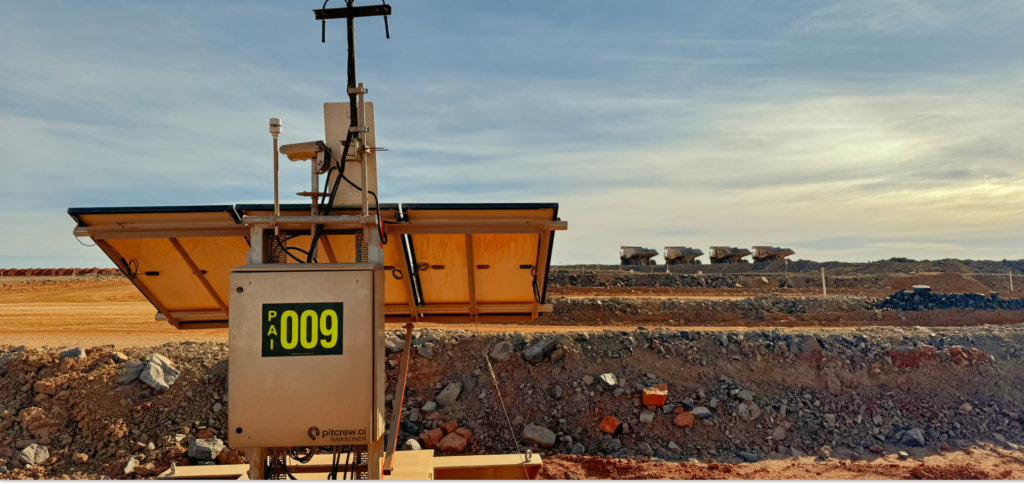
Pitcrew AI’s Autonomous Inspection System prevents tyre fires by detecting the thermal precursors to belt separation on every truck pass, giving maintenance teams the window to intervene before heat buildup reaches dangerous levels. The system is deployed at the roadside on the haul road. No stopping required. No human operator needed. It runs 24/7 without intervention.
How does continuous thermal monitoring work?
Pitcrew AIS uses FLIR thermal cameras mounted at the roadside to capture a complete thermal profile of every tyre on every axle as the truck drives through. The system’s proprietary computer vision models analyse each thermal image on edge compute hardware deployed at the inspection point.
The system detects localised thermal anomalies in the tread zone, the exact signature produced by belt separation before it progresses to thermal runaway. When an anomaly is detected, the system generates an alert to the maintenance team with the specific truck, axle position, and thermal data.
Why does continuous inspection beat periodic checks for tyre fire prevention?
A haul truck on a typical mine circuit passes the inspection point multiple times per shift. Each pass is a complete inspection of every tyre. This means the system captures the thermal progression from early-stage belt separation through escalating heat buildup, providing multiple opportunities to detect a developing fault before it becomes dangerous.
Pitcrew AI has completed more than 672,000 autonomous tyre inspections in the 12 months to early 2026, across 42+ global deployments. Tier-one mining customers across iron ore, copper and coal rely on Pitcrew AIS as their continuous tyre monitoring layer, complementing TPMS with the external thermal intelligence that internal sensors cannot provide.
How does early detection prevent tyre fires?
Traditional approaches to tyre fires are reactive. A fire starts. The road closes. Equipment is damaged. Operations lose hours.
Pitcrew AIS shifts the model to prevention. By detecting thermal precursors at the earliest stage, the system gives maintenance teams time to pull a truck from service, inspect the flagged tyre, and make a decision. If the carcass is still viable, early intervention preserves the option to retread, saving significantly compared to a full replacement. If replacement is needed, a controlled tyre change costs US$30,000 to US$70,000. A tyre fire event costs US$500,000 to US$2 million. Prevention is not just safer. It is dramatically cheaper.
Other tyre fire prevention measures in mining operations, including nitrogen inerting, tyre pressure management, and haul road maintenance, reduce fire risk but cannot detect a fault already in progress. Pitcrew AIS provides the detection layer that closes the gap between prevention best practices and a developing thermal event.
What Makes Thermal Imaging Effective for Mining Tyre Fire Detection?
Thermal imaging detects heat radiation from the tyre’s surface regardless of lighting conditions, dust, or time of day. This makes FLIR cameras effective in the 24/7 operating environment of an open-cut mine, where visible-light cameras and human inspectors are limited by darkness, dust, and fatigue.
Belt separation produces a characteristic thermal pattern. A localised hot zone appears in the tread area, typically 20°C to 50°C above the baseline temperature of the surrounding tread. This pattern is distinct from normal tyre heating caused by load and speed, which presents as a uniform temperature distribution.
Pitcrew AI uses FLIR thermal cameras specifically for their sensitivity and resolution in the temperature ranges relevant to tyre fault detection. The system’s AI models are trained on hundreds of thousands of real-world tyre thermal profiles from operating mine sites, enabling accurate differentiation between normal operating temperatures and fault-indicative anomalies. For more on how thermal detection works, see How Thermal Imaging Detects Tyre Faults.
Prevent mining tyre fires before they shut your haul road
Request a demo of Pitcrew AIS to see how autonomous thermal inspection protects your fleet and your production.
Frequently Asked Questions
Belt separation is the most common cause of a mining tyre fire. The unbonded steel and rubber layers generate friction heat during normal haulage, and if that heat is not detected it builds towards pyrolysis and ignition. Impact damage from haul road debris, overloading, and sustained underinflation are the usual triggers for the separation itself.
Once an OTR tyre is burning, site emergency procedures take over. Crews establish an exclusion zone because of toxic smoke and the risk of explosive debeading, and the tyre can burn for four to eight hours before the area is cleared. Suppression is difficult on an ultra-class tyre, which is why detecting the thermal precursors before ignition is the practical control.
Pitcrew AIS detects thermal anomalies on each truck pass. On a typical mine haul circuit, trucks pass the inspection station multiple times per shift. A developing belt separation that produces a detectable thermal signature will be flagged on the next pass, often within hours of the fault beginning to generate heat.
No. Pitcrew AIS complements TPMS. TPMS monitors internal tyre pressure and cavity temperature. Pitcrew AIS monitors external tread temperature and detects physical tyre damage such as belt separation. Together, they provide complete tyre health visibility across both internal and external conditions.
Pitcrew AIS is fleet-agnostic. It inspects all major ultra-class and large mining haul trucks, including the CAT 793, CAT 797, Komatsu 830E, Komatsu 930E, Liebherr T264, and Hitachi EH5000, as well as any other vehicle that passes through the inspection station.
Pitcrew AI deploys the AIS as a roadside station on the haul road. The system is typically trailer-mounted or skid-mounted for rapid deployment. Installation requires power and network connectivity. No modifications to trucks or haul roads are needed. Station installation takes a single day, and a typical deployment is fully operational within 4 to 8 weeks of project approval.
Yes. Pitcrew AIS operates in temperatures from -20°C to +55°C, in dust, rain, and darkness. The system is designed for continuous 24/7 operation in the harshest mining environments, from the Pilbara in Western Australia to high-altitude copper mines in Chile and Peru.
When Pitcrew AIS detects a thermal anomaly, it generates an alert sent to the site’s maintenance team via the Pitcrew dashboard. The alert includes the truck identification, the specific tyre position, the thermal image, and the severity classification. The maintenance team can then make an informed decision about whether to pull the truck for inspection.