

What Is Automated Vehicle Inspection? How Autonomous Systems Are Changing Fleet Safety
TL;DR
Heat is the earliest honest signal a heavy vehicle gives before something fails. A belt separation inside an off-the-road tyre casing generates friction heat long before the tread shows a bulge, and a dragging brake runs hot long before smoke appears. Thermal imaging reads that signal on every pass.
Key Takeaways
- Automated vehicle inspection uses sensors, imaging and artificial intelligence to assess vehicle condition consistently as vehicles move through an inspection point.
- An autonomous inspection vehicle usually means a mobile robot or rover, but fixed, drive-through inspection stations suit high-utilisation haul fleets better.
- The Pitcrew Autonomous Inspection System (AIS) performs external thermal inspection with no vehicle modifications, no stoppages and no production delays.
- For autonomous haulage fleets, roadside inspection restores the visibility lost when there is no driver to complete walk-arounds or notice a developing tyre issue during operation.
- Thermal inspection is one layer within a multi-method tyre programme: it complements a Tyre Pressure Monitoring System (TPMS) and does not replace pre-start checks.
What is automated vehicle inspection?
An automated vehicle inspection system uses cameras, sensors, computer vision and analytics to assess vehicle condition with minimal manual intervention. Instead of a technician walking around a truck with a handheld device, the inspection happens on its own, to the same standard, every time.
Two architectures dominate. The first is mobile: robots, rovers and drones that travel to the asset and inspect it where it sits. The second is fixed: a drive-through station that stays in place and inspects each vehicle as it passes. For heavy mining and transport fleets, choosing between those two models is the decision that shapes everything downstream, from installation cost to how many inspections you actually get.
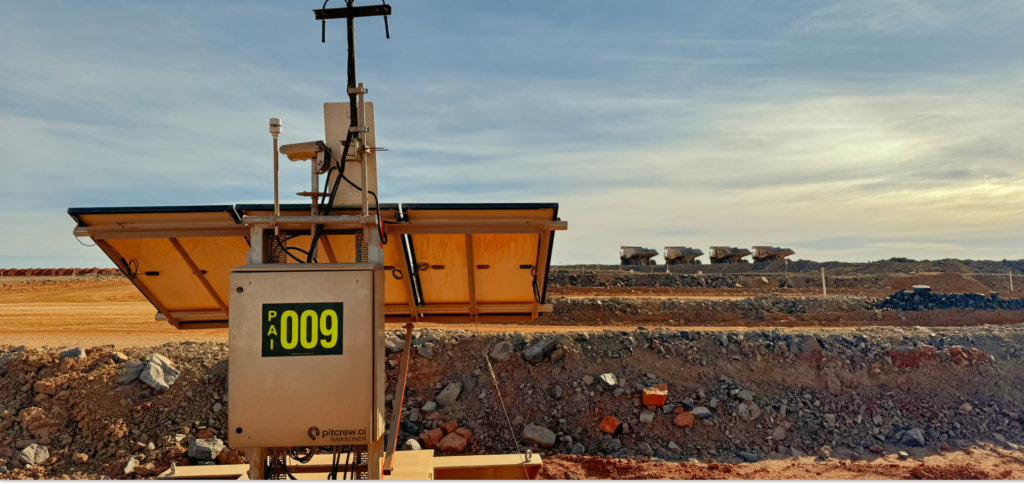
Pitcrew AIS sits in the second category. It is an infrastructure-based system built for heavy vehicles moving at normal site speeds, and it looks at tyre tread surface temperature and developing thermal anomalies, plus brakes, hubs and bearings. Each pass produces a timestamped, objective record for maintenance and safety teams. That lifts inspection frequency and consistency, but it remains one component of a broader maintenance and tyre-management programme.
What is an autonomous inspection vehicle, and why is a fixed station often better for haul fleets?
An autonomous inspection vehicle is typically a self-moving robot, rover or drone that travels to inspect an asset, while a fixed station keeps the inspection equipment in one place and lets vehicles pass through it. Most people searching the term picture the robot. Pitcrew inverts the model: the truck moves, the inspection system stays still.
The practical difference is operational. A mobile system has to navigate site conditions, find the asset, manage its own charging and keep clear of production traffic. A fixed station sits at a predictable, high-traffic point: a haul road, a workshop approach, a fuel bay, a depot entrance or exit route.
Haul trucks repeat defined routes and pass the same points dozens of times a shift. The station inspects without stopping the truck or adding a separate task to anyone’s day, and one installation covers a whole fleet rather than visiting one vehicle at a time.
| Consideration | Mobile inspection vehicle | Vehicle-mounted system | Fixed drive-through station |
|---|---|---|---|
| Where the technology sits | On a rover or drone that travels to the asset | On every truck in the fleet | Roadside, trailer- or skid-mounted |
| Vehicle modifications | None | Required on each unit | None |
| Inspection frequency potential | Limited by travel and charging | Continuous but sensor-specific | Every pass, 24/7 |
| Suitability for autonomous haulage | Interaction risk with autonomous traffic | Fitment triggers safety-case review | Well suited, no driver interaction |
| Interruption and overhead | Site navigation and asset location | Installation and sensor servicing per truck | No production delay, remote diagnostics |
Why does no vehicle fitment matter for autonomous haulage fleets?
No vehicle fitment matters because modifying an autonomous haul truck can require re-certification of the autonomous system’s safety case, which adds cost, time and operational risk. Roadside infrastructure carries none of that.
The arithmetic is stark on a 50-truck fleet. At six tyres per truck, an in-tyre monitoring rollout means 300 individual sensor installations, then battery management and reinstallation at every tyre change. One roadside Pitcrew AIS station provides fleet-wide external inspection with zero truck downtime for installation.
That is not an argument against TPMS. A Tyre Pressure Monitoring System measures internal pressure and cavity temperature. Pitcrew AIS measures external tread surface temperature and the thermal signatures associated with structural damage. Neither replaces the other, and used together they cover the inside and the outside of the tyre.
The gap this closes is growing quickly. GlobalData put the global autonomous haul truck fleet at 3,832 units in July 2025, up 84% from 2,080 a year earlier. Australia operates 1,024 of them, the second-largest national fleet. Projections point to close to 5,000 trucks by 2030, still under 6% of roughly 64,600 active rigid trucks.
Removing the driver removes three inspection layers at once: pre-start walk-arounds performed two to three times daily, sensory detection during operation such as vibration from a separating tread or the smell of burning rubber, and informal checks at fuel bays, load points and parking areas. Autonomous haulage trucks also run around 700 additional hours a year, so the asset works harder with fewer human eyes on it.
How does a drive-through automated vehicle inspection system work?
A drive-through system captures thermal and visual data as the vehicle passes a fixed station, then analyses it within seconds to identify and classify anomalies. The truck never slows down.
The Pitcrew AIS sequence runs like this: the truck approaches at normal operating speed, FLIR thermal imaging captures external temperature data from tyres and components, computer vision locates tyre positions, and edge processing analyses the images on site for real-time anomaly detection, including where connectivity is limited. Results are then stored and pushed to maintenance and operations teams.
Vehicle identification is what makes the pipeline usable. iTrack reads the unit number off the truck body using computer vision and matches it to the site fleet database. No radio-frequency identification tags, no transponders, no vehicle-mounted hardware. Without reliable identification, every scan would need manual matching to a truck.
Each pass creates a record containing truck identification, tyre position, thermal image, measured temperatures, a severity classification and the inspection history behind it. The station is trailer- or skid-mounted and relocatable as site plans change, solar-powered with battery backup or grid-connected where required, rated in IP66 enclosures for operation from -20°C to +55°C. Typical deployment runs four to eight weeks with zero fleet downtime.
What coverage and detection capability can automated thermal inspection provide?
Automated drive-through inspection delivers 20 to 40 or more inspections per truck per 24 hours, against one or two manual checks, depending on route frequency and site layout. A truck completing 20 to 30 cycles per shift may receive 40 to 60 inspections a day.
Compare that with a handheld programme. Weekly scans leave roughly 98.8% of the operating week unmonitored. Monthly scans push that to about 99.7%.
Repeat data changes what the analysis can do. Thermal anomalies are trended across multiple passes rather than judged from one snapshot, which helps maintenance teams separate a developing fault from a temporary operating variation. Pitcrew deployment data shows a median detection lead time exceeding 72 hours, with some slow-developing belt separations identified up to six weeks earlier.
Pitcrew AIS achieves approximately 95% sensitivity for tread separations producing a thermal signature above the detection threshold. Detection depends on line of sight, and the system cannot see the far sidewall. Thick snow, mud or material covering the tyre surface limits thermal visibility. Thermal monitoring is not a guarantee against every failure mode, and it does not replace pre-start checks or tyre technician assessments.
How does an automated vehicle inspection system turn data into maintenance action?
Inspection data creates value only when a result triggers a defined response. Trigger Action Response Plans (TARPs) are the framework that links severity to action.
A typical escalation looks like this: an advisory notification for a low-level anomaly requiring review, a watch alert at a 30°C temperature differential, and an immediate pull-from-service response at 50°C. Thresholds and escalation pathways should be configured to site conditions, tyre programme requirements and existing risk controls.
Results move through a Representational State Transfer Application Programming Interface (REST API), webhooks for near-real-time notification, Comma-Separated Values (CSV) or Excel export, or a direct feed to Autonomous Haulage System (AHS) control systems for dynamic truck rerouting where deployed. Pitcrew AIS integrates with Computerised Maintenance Management System (CMMS) platforms including SAP Plant Maintenance, Pronto, Ellipse and IBM Maximo, and with fleet management systems including Wenco, Modular Mining DISPATCH and Caterpillar MineStar.
Without a TARP and named ownership, inspection data sits passively in a dashboard instead of supporting timely intervention.
What costs can automated vehicle inspection help fleets avoid?
The avoidable costs are missed developing defects, downtime spent on manual inspection, and preventable secondary tyre or component damage.
Off-The-Road (OTR) tyres commonly cost US$30,000 to US$70,000 or more each, depending on size, brand and contract arrangements. A developing tread or belt separation that goes unnoticed can escalate from a repairable condition into a casing-destroying event.
Manual thermal inspection is estimated at US$1,175 to US$2,950 per truck per year, plus more than 30 minutes of truck downtime per scan. A 40-truck fleet on weekly scans can spend roughly US$118,000 annually and receive 52 partial-surface snapshots per truck for it.
Downtime context varies by commodity. Iron ore haul truck downtime runs approximately US$18,000 to US$32,000 per truck-hour, though site economics shift with utilisation, maintenance strategy and production constraints. The financial case rests on risk reduction and operational continuity: more opportunities to catch an anomaly before it escalates, less reliance on scheduled stoppages for external checks, and better prioritisation of tyre-service decisions.
Assess automated inspection for your fleet
If you are weighing a mobile inspection platform against roadside infrastructure, the deciding factors are fitment cost, inspection frequency and how the data reaches your maintenance system. Request a demonstration or a site assessment to see how Pitcrew AIS would be configured for your haul roads, fleet mix and existing tyre programme.
What are common questions about automated vehicle inspection?
No. Automated inspection adds frequent, objective condition data between pre-start checks and technician inspections. A sound tyre programme combines visual assessment, manual measurement, internal pressure monitoring and external thermal monitoring, because each method sees something the others miss.
Yes. Fixed drive-through inspection suits autonomous haulage because it needs no driver interaction and no vehicle-mounted hardware. Results can feed into Autonomous Haulage System workflows for review, response and truck rerouting where the site has that capability configured.
No. Pitcrew AIS complements TPMS. TPMS monitors internal pressure and cavity temperature from inside the tyre and requires per-tyre fitment. Pitcrew AIS monitors external tread surface temperature and structural thermal signatures from the roadside with nothing fitted to the vehicle. Run together, they cover both sides of the same asset.
Thermal inspection identifies developing external heat patterns associated with tread or belt separation, brake drag, bearing overheating and hub-related anomalies. Detection requires a visible thermal signature, clear line of sight and a tyre surface not obscured by thick mud, snow or carryback material.
Yes. Pitcrew AIS is fleet-agnostic and configurable for major haul truck platforms including Caterpillar 793 and 797, Komatsu 830E and 930E, Liebherr T264 and Hitachi EH5000, covering tyre sizes from 27.00R49 through to 59/80R63, with no modification to the vehicle.