

Understanding the Cost of Mining Truck Downtime
TL;DR
A single Off-The-Road (OTR) tyre failure on an ultra-class haul truck costs between US$80,000 and US$400,000 when all direct and indirect costs are included. The industry average sits at approximately US$180,000 per incident. If the failure escalates to a tyre fire, costs can exceed US$10 million. Nine out of ten failed OTR tyres are damaged beyond repair, meaning the full replacement cost is incurred in almost every event. These economics make early detection through continuous thermal monitoring a significant financial lever for mining operations.
How Much Does a Single OTR Tyre Failure Cost?
A single OTR tyre failure on an ultra-class haul truck costs between US$80,000 and US$400,000 in total, with most incidents falling in the US$120,000 to US$200,000 range. The variation reflects operational context: a routine tyre change in an accessible location sits at the lower end, while a failure involving collateral damage or safety investigation pushes costs toward the upper bound.
The replacement tyre alone accounts for US$30,000 to US$100,000 depending on size and brand. A CAT 797F running 59/80R63 tyres faces a per-tyre replacement cost of US$45,000 to US$100,000. A CAT 793 or Komatsu 830E on 40.00R57 tyres costs US$30,000 to US$50,000 per tyre. These figures reflect negotiated contract pricing for Tier 1 brands (Bridgestone, Michelin, Goodyear). During the 2008 supply crisis, spot prices surged by as much as 425%.
Cost breakdown per tyre failure event
| Cost Component | Typical Range (USD) |
|---|---|
| Replacement tyre | $30,000 – $100,000 |
| Labour and equipment | $5,000 – $15,000 |
| Rim and wheel damage (occurs in ~30% of events) | $0 – $30,000 |
| Lost production (4-8 hours) | $20,000 – $160,000 |
| Emergency towing and recovery | $2,000 – $10,000 |
| Investigation and incident management | $2,000 – $10,000 |
| Total per event | $80,000 – $400,000 |
OTR tyres account for 20 to 25% of total haul truck operating costs, second only to fuel. This places tyres among the largest line items in the maintenance cost of a mining truck. For a fleet of 40 ultra-class trucks carrying 240 tyres, the rolling tyre inventory represents over US$12 million in asset value on the ground at any time. What starts as a small rock impact in a loading bay can progress through internal friction and heat to a total-loss fire within days, with the truck operating normally between inspections. Each unplanned failure also draws down strategic spare inventory, and lead times for ultra-class OTR tyres can run months, compounding procurement pressure.
What Does Lost Production Add to the Cost of Mining Truck Downtime?
Lost production is frequently the largest single cost component of a tyre failure, often exceeding the replacement tyre cost itself. The mining haul truck downtime cost per hour sits between US$5,000 and US$20,000 in lost production, and a standard tyre change takes 4 to 8 hours depending on tyre position and crew availability. That translates to US$20,000 to US$160,000 in production losses per event.
The cost varies significantly by commodity. Based on commodity-specific production analysis, iron ore operations in the Pilbara face downtime costs of US$18,000 to US$32,000 per truck-hour, driven by ultra-class payloads and high ore value. Copper porphyry operations typically sit lower at US$5,000 to US$14,000 per truck-hour, while metallurgical coal operations range from US$11,000 to US$25,000 per truck-hour.
A disabled truck also disrupts the broader fleet. When a truck is immobilised on a single-lane haul ramp, every other truck on that circuit must take an alternate route. Adding approximately 5 minutes per cycle to 10 to 15 trucks is equivalent to idling one full truck’s production capacity. This cascade effect adds US$5,000 to US$50,000 depending on how long the disruption persists. Much of this is unplanned downtime on mining equipment that earlier detection could have converted into a scheduled removal.
What Happens When a Tyre Failure Escalates to Fire?
A tyre fire is the most expensive outcome of a tyre failure, costing between US$200,000 and over US$10 million depending on severity. If the truck is destroyed, the vehicle replacement cost alone ranges from US$5 million to US$8 million for an ultra-class haul truck.
In a documented 2025 incident, a failed park brake piston seal on an Australian coal producer’s EH5000AC dump truck caused a rapid tyre fire that resulted in total machine loss, a single-event cost exceeding US$6 million. In a separate Queensland incident, a dump truck being escorted to a hot tyre bay caught fire and was totally destroyed. The NSW Resources Regulator issued Safety Bulletin SB23-09 documenting three separate tyre fire incidents at coal mines, noting poor emergency response including personnel entering active exclusion zones.
Australian state regulators (Queensland RSHQ, NSW Resources Regulator, WA DMIRS) mandate a minimum 300-metre exclusion zone for at least 24 hours after a tyre fire. Tyres can re-ignite during the cooling period because pyrolysis, the chemical decomposition of rubber at approximately 250 degrees Celsius, produces volatile compounds that can auto-ignite at approximately 430 degrees Celsius. The total disruption period from incident detection through road clearance typically runs 24 to 48 hours.
Why Are 90% of Failed Tyres Beyond Repair?
Nine out of ten OTR tyres that suffer a failure event are damaged beyond repair, according to OTR repair specialist TyreDoctor. Catastrophic failure destroys the tyre casing through heat damage, structural deformation, or both, eliminating any possibility of repair or retreading.
When repair is viable (approximately 10% of cases), the cost sits at 10 to 15% of a new tyre price. A US$50,000 tyre that sustains a repairable injury costs US$5,000 to US$7,500 to restore. This only applies to minor punctures without carcass damage, localised sidewall cuts, or limited tread separation. The vast majority of failure events produce damage well beyond these thresholds.
This 90% write-off rate reinforces the financial case for prevention. Approximately 40 to 50% of OTR tyres at typical mining operations fail prematurely, before reaching their designed wear-out life. Peer-reviewed studies at Rossing Uranium Mine in Namibia documented a 49% premature failure rate, while a South African iron ore operation recorded 41%. At a 100-truck fleet generating roughly 500 tyre service events per year, even a modest reduction in premature failures delivers substantial cost avoidance. Read more about OTR tyre failure rate data.
How Can Mining Operations Reduce the Cost of Mining Truck Downtime?
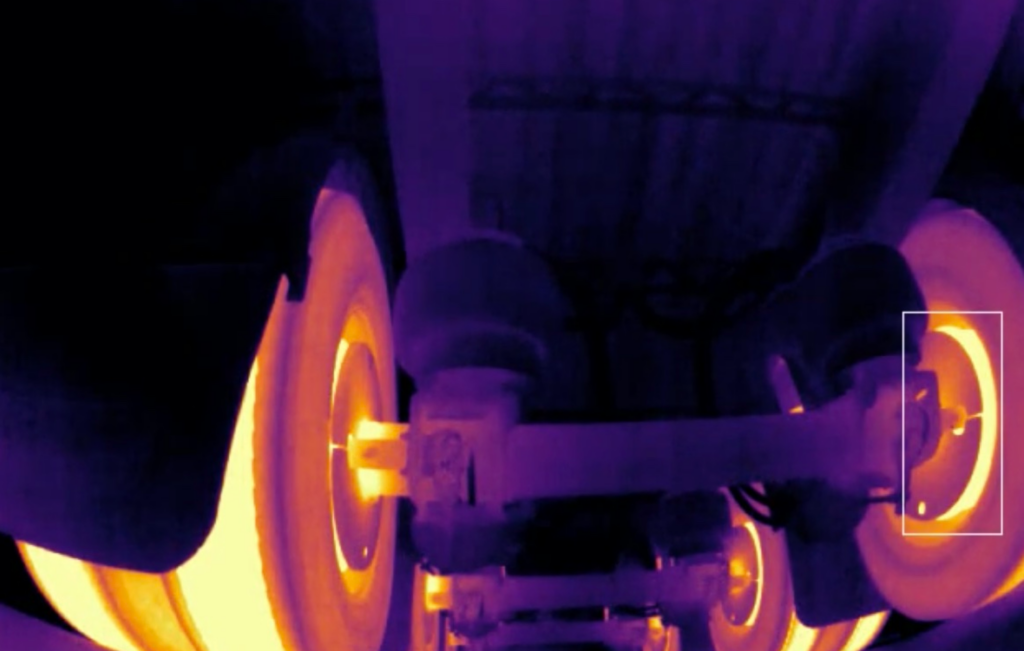
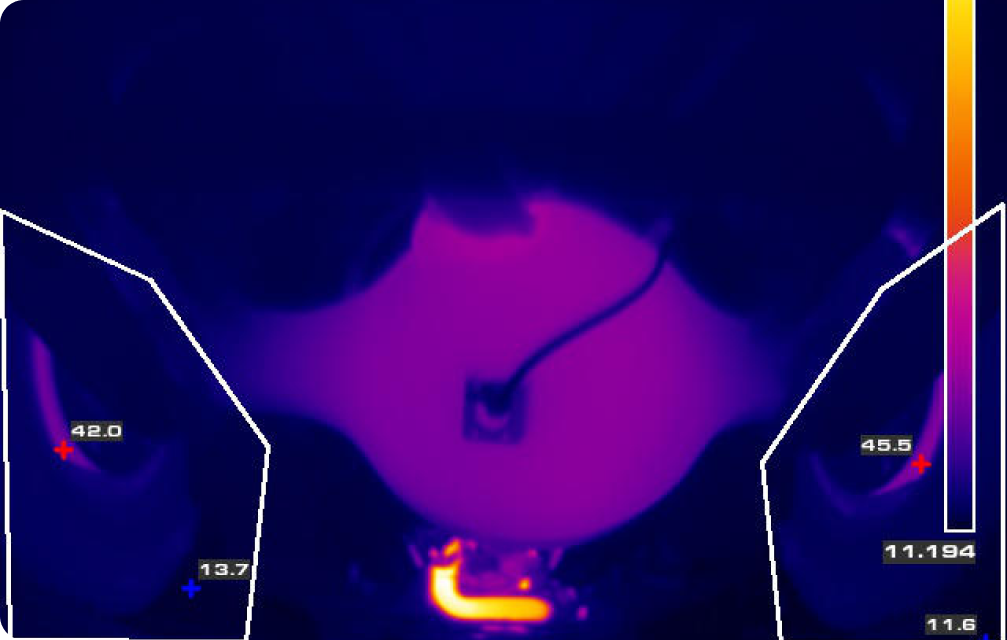
Continuous thermal monitoring detects the tread separations and internal heat anomalies that precede catastrophic failure, often days before a blowout or fire occurs. A developing failure produces a localised hot spot 20 to 50 degrees Celsius above normal operating temperature, detectable well before the tyre reaches the critical threshold. Thermal imaging of tyre faults gives crews the lead time to plan a removal rather than absorb the maintenance cost of a mining truck pulled out of service unexpectedly.
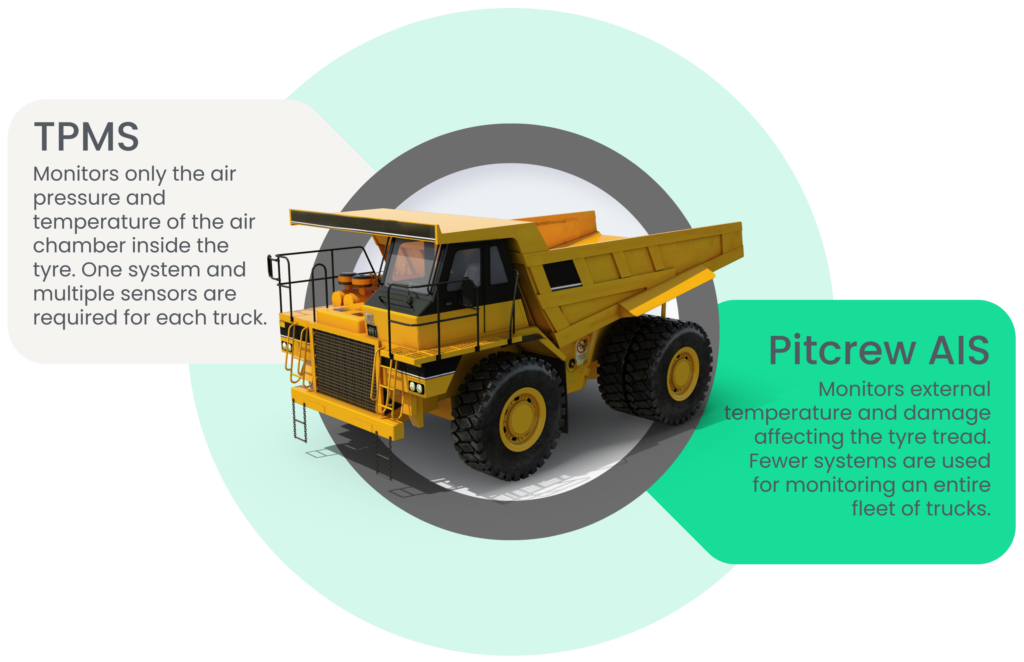
Manual visual inspections cover only about half of an OTR tyre’s surface and typically happen once per week, requiring 10 to 30 minutes of truck downtime per inspection. Tyre Pressure Monitoring Systems (TPMS) track internal pressure and chamber temperature but cannot detect tread separations or subsurface heat pockets. These gaps mean the majority of developing thermal and structural failures go undetected until catastrophic failure occurs.