

ADG Code Compliance for Dangerous Goods Vehicle Inspection
TL;DR
Western Australia’s Regulation 170A, effective 18 April 2025, is the world’s first tyre temperature monitoring mandate for ammonium nitrate transport vehicles. The regulation was catalysed by the 24 October 2022 Great Central Road explosion, the first ammonium nitrate emulsion (ANE) transport detonation globally since bulk ANE transport began in the 1980s. The WA Code of Practice recognises two monitoring approaches: manual temperature checks and vehicle-fitted TPMS. Automated roadside thermal inspection provides a complementary third layer, detecting external thermal faults that neither mandated approach covers. For broader mining safety context, see reducing unplanned downtime in mining fleets.
What does WA Regulation 170A require for ammonium nitrate transport?
Regulation 170A mandates temperature monitoring of tyres and wheel components on all vehicles transporting ammonium nitrate (AN) explosion risk goods in Western Australia. Effective 18 April 2025, it is the world’s first regulation to specifically require tyre temperature monitoring for AN transport, verified against comparable frameworks in the United States, Canada, the United Kingdom, South Africa, and UN Model Regulations.
The accompanying Code of Practice, “Minimising the risk of tyre fires when transporting ammonium nitrate explosion risk goods,” defines two mandatory monitoring approaches. Section 4.1 covers manual monitoring using a calibrated thermal imaging camera (TIC) or thermometer at loading, unloading, and fatigue breaks, with records retained for three months. Section 4.2 covers automatic monitoring via a Tyre Pressure Monitoring System (TPMS) with temperature capability, requiring real-time data, not post-journey analysis.
The Code does not address automated roadside thermal inspection. This third approach is neither prohibited nor endorsed, creating a regulatory gap that operators can fill as additional due diligence under Chain of Responsibility (CoR) obligations.
What caused the Great Central Road ammonium nitrate explosion?
On 24 October 2022, a double road train carrying 61.61 tonnes of ammonium nitrate emulsion (ANE) detonated on the Great Central Road, approximately 150 kilometres east of Laverton in Western Australia. The Department of Mines, Industry Regulation and Safety (DMIRS) classified it as “the world’s first detonation involving ANE during transport since bulk transport of ANEs was introduced in the 1980s.”
The root cause was brake system failure. Loss of air pressure in the brake system caused brake drag on the rear tanker trailer, which carried 33.85 tonnes of ANE. The resulting friction ignited the tyres. The driver detected the fire at 9:31 AM and fought it for 14 minutes before decoupling the trailer. Detonation occurred at 11:33 AM, two hours and two minutes after detection. The blast, equivalent to 1 to 3 tonnes of TNT, created a crater 17 metres long and 9 metres wide. Shrapnel was found up to 672 metres from the blast site.
This was not an isolated event. DMIRS reported more than 12 tyre fire incidents on AN transport vehicles to the United Nations Economic Commission for Europe (UNECE). Five additional ANE incidents in aluminium tankers are documented in the DMIRS investigation report, spanning Western Australia, Queensland, and Norway between 2013 and 2023. These incidents collectively drove the legislative response that became Regulation 170A.
Why does TPMS alone leave a gap in AN transport monitoring?
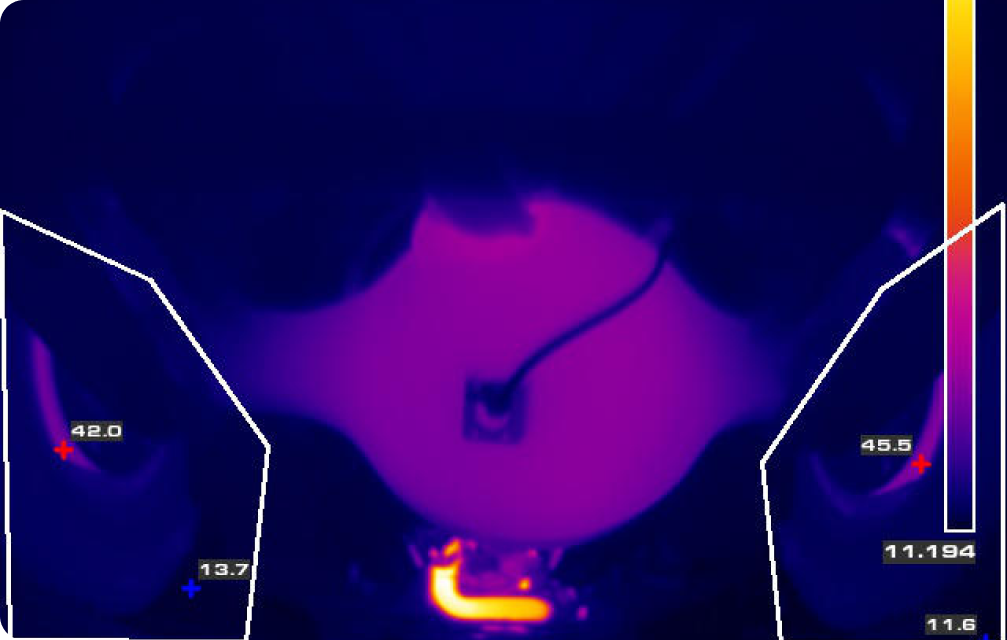
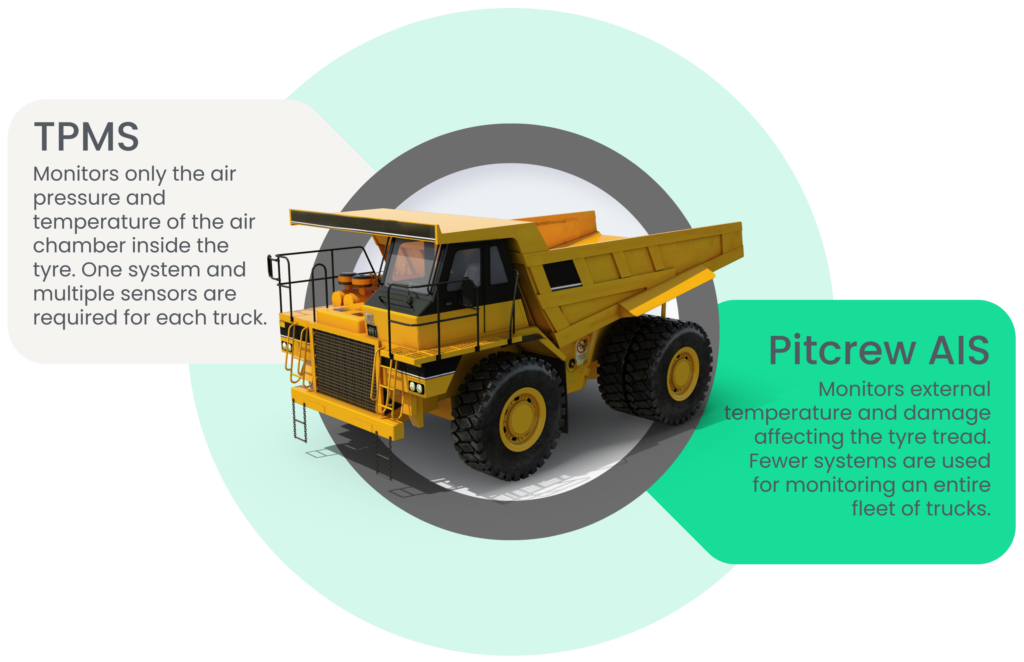
TPMS monitors internal tyre pressure and cavity temperature. It is effective for detecting under-inflation and slow leaks, but it has a documented blind spot for external thermal events. Queensland’s Resources Safety and Health Queensland (RSHQ) Recognised Standard 13 (v2.0, June 2024) identifies TPMS as a “prime alert mechanism” but warns that it “may not respond to rapid temperature rise in time.”
The DMIRS investigation report reinforces this concern. It notes that temperature measurements on a periodic basis have limitations, and that “a tyre fire can occur between measurements.” The report concludes:
“Ideally, a constant monitoring system is needed that alerts the driver of overheating problems during travel.”
DMIRS, Ammonium nitrate emulsion tanker trailer explosion: Incident investigation report (2023)
Fifty-four percent of wheel-end fires are not caused by pressure loss alone. External faults, including tread separations, bearing failures, and brake drag, produce thermal signatures visible on the tyre and wheel surface but invisible to sensors inside the tyre cavity. For a detailed comparison of what each monitoring approach detects, see TPMS vs external thermal monitoring.
How drive-through vehicle inspection for dangerous goods addresses the monitoring gap
Automated roadside thermal inspection provides continuous external screening of every AN transport vehicle at fixed points along transport corridors. The Pitcrew Autonomous Inspection System (AIS) uses FLIR thermal imaging and computer vision to detect brake drag, bearing overheating, tread separations, and developing tyre fires as vehicles pass at speed. No equipment is fitted to the vehicle.
For AN transport operations, the natural installation points are AN loading depots, mine site entry gates, designated rest stops, and town bypasses. Every vehicle is screened on every pass, creating timestamped inspection records that serve as evidence of proactive due diligence under CoR obligations. This drive-through vehicle inspection approach supports broader dangerous goods transport compliance obligations. Pitcrew AIS has completed millions of component inspections across mining and transport operations globally. This approach complements manual checks and TPMS rather than replacing them, addressing the specific failure modes that the two mandated approaches do not cover.
| Feature | Manual TIC (Section 4.1) | TPMS (Section 4.2) | Roadside Thermal (Pitcrew AIS) |
|---|---|---|---|
| Measurement | Spot temperature reading | Internal pressure and cavity temperature | External tread, sidewall, brake, hub temperature |
| Frequency | At loading, unloading, and breaks | Every 3-15 minutes | Every pass through inspection point |
| Coverage | Intermittent, operator-dependent | Continuous on fitted tyres | Continuous at fixed points |
| Vehicle modification | None | Sensors fitted inside each tyre | None |
| Detects external faults | Yes (at check points only) | No | Yes (automatically) |
| Audit trail | Manual records (3-month retention) | Electronic data log | Timestamped inspection records |
What are the Chain of Responsibility penalties for dangerous goods transport?
Chain of Responsibility (CoR) provisions under the Heavy Vehicle National Law (HVNL) apply to every party in the AN transport supply chain, from manufacturers and consignors to transport operators and mine site receivers. Corporate penalties for CoR breaches reach $3,987,760. Individual penalties reach $398,776, with imprisonment of up to five years for the most serious offences (2024-25 indexed figures).
The “reasonable steps” defence requires demonstrable evidence of due diligence. Automated monitoring records, including timestamped thermal inspection data, can form part of this evidence base.
Frequently Asked Questions
The Australian Dangerous Goods (ADG) Code is the national framework for the road and rail transport of dangerous goods in Australia. ADG Code compliance covers classification, packaging, labelling, documentation, and vehicle requirements, and vehicles carrying dangerous goods must be kept in a safe and roadworthy condition, with particular attention to brakes, tyres, and electrical systems. Regulation 170A sits alongside the ADG Code in Western Australia for ammonium nitrate transport.
The cost of a manual heavy vehicle inspection varies by provider, vehicle type, and jurisdiction. DG vehicle inspection requirements add further checks on brakes, tyres, and thermal condition for vehicles carrying dangerous goods. Automated drive-through thermal inspection screens every vehicle on every pass without per-inspection booking fees, generating compliance-ready records that support due diligence.
No. The WA Code of Practice specifies two monitoring approaches: manual temperature checks (Section 4.1) and vehicle-fitted TPMS (Section 4.2). Automated roadside thermal inspection is not addressed in the Code. It is neither prohibited nor required. Operators deploying roadside thermal inspection do so as additional due diligence above the regulatory baseline.
No. TPMS detects pressure loss and internal cavity temperature changes. It does not detect external faults such as tread separations, bearing failures, or brake drag, which account for a significant proportion of wheel-end fire causes. Queensland RSHQ RS13 warns that TPMS “may not respond to rapid temperature rise in time.”
Western Australia is the largest AN-producing state in Australia. Approximately 60 AN road trains operate daily across major transport corridors from Perth and Kwinana to the Goldfields, Pilbara, and Mid West mining regions. Major AN suppliers include Orica, Dyno Nobel, and CSBP. Around 35 licensed AN transporters operate in WA.
Automated thermal monitoring creates timestamped, objective inspection records for every vehicle passage. These records demonstrate proactive risk management and can support the “reasonable steps” defence under CoR obligations. Combined with mandatory manual checks and TPMS, automated thermal monitoring provides a multi-layered approach to AN transport safety that strengthens an operator’s due diligence position. Request a demo to see how Pitcrew AIS generates compliance-ready inspection records.