

Fleet
DRIVE THROUGH FLEET TYRE MONITORING FOR HEAVY VEHICLES
Non-intrusive thermal condition monitoring that detects faults in tyres, brakes, and bearings at depot entry and exit points, supporting Chain of Responsibility compliance under the Heavy Vehicle National Law.
Pitcrew AIS automates heavy vehicle fleet inspection at depot entry and exit points using three FLIR thermal cameras and computer vision. The system detects brake, tyre, and bearing faults through thermal asymmetry detection across axle groups, with no vehicle modifications or driver intervention. Timestamped inspection records support Chain of Responsibility (CoR) compliance under the Heavy Vehicle National Law (HVNL). The system screens B-doubles and multi-combination heavy vehicles during normal depot traffic flow.
The on-road inspection challenge is growing as mining operations increasingly use road-going vehicles for longer-distance haulage, alongside traditional depot-to-site heavy vehicle fleets. Looking for mining haul truck inspection? See Pitcrew AIS for mining operations.
Trusted by





Why do manual pre-departure inspections miss critical faults?
Industry data indicates manual visual inspection detects only 10 to 20 percent of developing thermal faults in tyres, brakes, and bearings. Visual checks cannot detect internal heat build-up in brake components, early-stage tread separation, or rising bearing temperatures. These faults produce measurable temperature signatures hours before they cause roadside failures.
Drivers face time pressure to depart. Inspection quality varies between individuals and shifts. A walk-around confirms obvious damage (low tread, a flat tyre) but cannot detect brake drag, rising hub temperature, or internal tyre separation.
Under the HVNL, CoR obligations extend beyond the driver to every party responsible for safe vehicle operation. An inconsistent, paper-based inspection process creates weak evidence in a regulatory investigation.
How does our truck tyre monitoring system work for fleets?
Pitcrew AIS captures a complete thermal profile of every vehicle passing through a depot entry or exit point.
-
01
Scan
Three FLIR thermal cameras (one in-road surface-mounted, one on each side of the lane) scan brakes, inner and outer tyre sidewalls, hubs, and bearings as vehicles pass at normal speed. No stopping. No driver action. No vehicle modifications.
-
02
Compare
Thermal asymmetry detection compares left-to-right and axle-to-axle temperature patterns to identify components running outside normal range. Even a few degrees between opposing brakes or bearings can indicate a developing fault, while larger deltas signal immediate maintenance action.
-
03
Flag & release
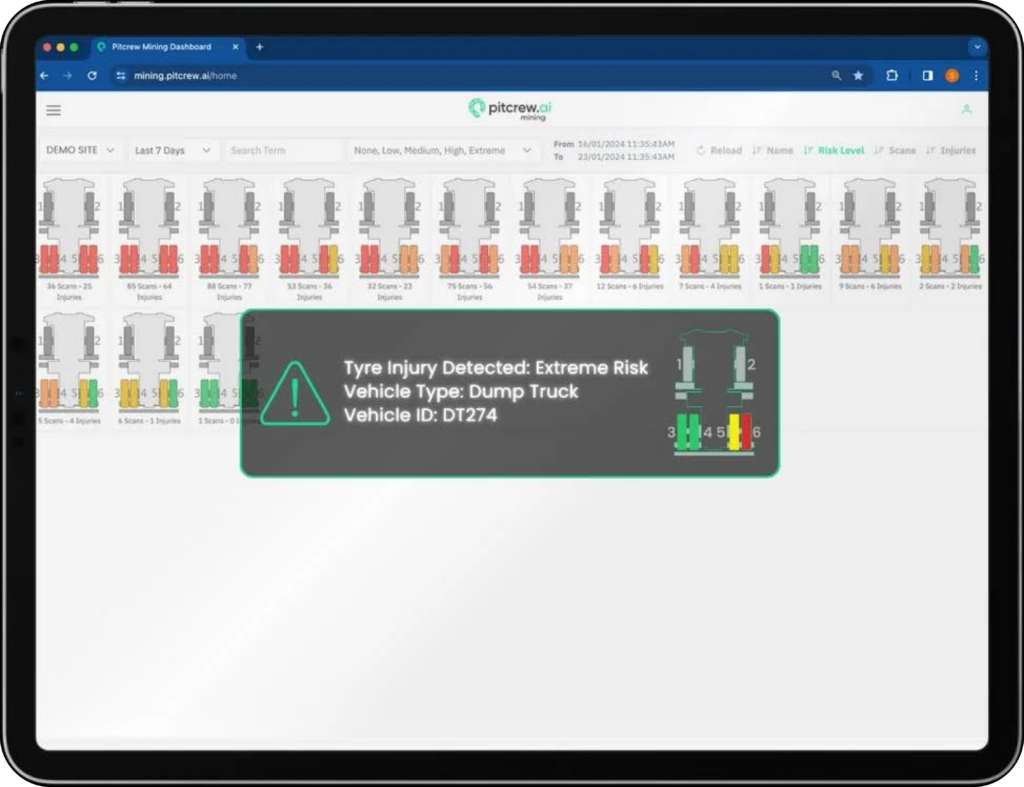
Results flow to the Pitcrew AI cloud dashboard. Integration with fleet management systems enables conditional release: vehicles with detected faults are flagged for maintenance before departure, while clean vehicles proceed without delay.
What faults does the Pitcrew AIS detect on heavy vehicles?
Pitcrew AIS detects developing faults across four component groups using thermal asymmetry detection.
| Component | What Is Detected | Method |
|---|---|---|
| Brakes | Overheating, friction anomalies, seized callipers, dragging brakes | Thermal asymmetry between paired brake assemblies |
| Tyres | Tread separation, underinflation signatures, progressive degradation | Surface temperature patterns and cross-axle comparison |
| Bearings | Rising hub temperatures indicating wear or imminent failure | Absolute temperature and trend analysis |
| Wheel assemblies | Load distribution problems, imbalance | Asymmetric thermal patterns across dual-tyre assemblies |
Maintenance technicians go directly to the specific wheel station that requires attention, rather than diagnosing a vague report from a driver. The system generates axle-by-axle condition reports with pass/fail ratings.
Our Technology
How does automated inspection support Chain of Responsibility compliance?
Automated thermal inspection generates timestamped, objective records of vehicle condition for every movement through the depot. Under the HVNL, every party in the heavy vehicle supply chain shares responsibility for vehicle safety (CoR duties, HVNL Chapter 2). Fleet operators must demonstrate due diligence in vehicle condition monitoring.
Pitcrew AIS provides a consistent, repeatable inspection process that removes variability between individual inspectors and shifts. Every vehicle is assessed against the same thermal criteria. The resulting records show when the vehicle passed the inspection point, what axle groups were screened, and which thermal exceptions were detected. This data is stored in a secure cloud environment, creating an auditable trail for compliance reviews and regulatory investigations.
This automated documentation supports CoR obligations without adding to existing departure workload.
What are the operational benefits for fleet managers?
Automated truck tyre monitoring reduces fault rates, compliance costs, and unplanned maintenance. Detecting developing issues before vehicles leave the depot shifts maintenance from reactive to predictive.
| Capability | Manual Inspection | Pitcrew AIS Automated Inspection |
|---|---|---|
| Consistency | Varies by inspector, shift, and time pressure | Same thermal criteria, every vehicle, every pass |
| Detection scope | Visual and tactile only | Thermal: brakes, tyres, bearings, hubs |
| Developing fault detection | 10–20% of developing thermal faults | Thermal anomalies detected before visible symptoms |
| Operating conditions | Tropical, arid, and cold climates. Sea level to 4,500 metres altitude. | |
| Vehicle downtime | Truck stopped for walk-around | No stoppage required |
| Record keeping | Paper or app checklist, often subjective | Timestamped digital records |
| CoR compliance evidence | Inspector-dependent | Objective, auditable, consistent |
| Fleet-wide trending | Not practical at scale | Centralised dashboard across all vehicles and depots |
| Maintenance approach | Reactive (fix when broken) | Predictive (fix before failure) |

Fewer roadside defects
Detect and resolve issues before vehicles leave the depot, reducing on-road faults and regulatory infringements.
Predictive maintenance
Thermal trend data enables condition-based scheduling, reducing both emergency repairs and unnecessary preventive replacements.
Fleet-wide visibility
Centralised reporting identifies fleet-level trends and maintenance priorities across all vehicles and depots.
Strengthen Your Fleet Safety Programme
Evaluate Pitcrew AIS for your depot network. See automated thermal inspection in operation, or request a fleet assessment to scope deployment for your fleet.
Frequently Asked Questions
Yes. Pitcrew AIS is designed to inspect semi trucks, B-doubles, and multi-combination vehicles as they pass through depot entry and exit points at normal speed. The three-camera configuration captures thermal data from brakes, tyres, hubs, and bearings across all axle groups, including trailer axles. This makes it a practical semi truck tyre monitoring system for any fleet running scheduled depot departures.
Trailer tyres are harder to monitor because trailers rotate between prime movers and often sit idle between runs. Pitcrew AIS scans every axle on every pass, regardless of which prime mover is pulling the trailer. This gives fleet managers continuous fleet trailer tyre health monitoring data tied to the trailer itself, not just the truck. Developing faults on trailer tyres, which account for a disproportionate share of roadside defects, are flagged before departure.
Pitcrew AIS was originally developed for haul truck tyre monitoring in open-cut mining operations, where a single OTR tyre failure can cost US$150,000 to $500,000 in direct costs and downtime. The same thermal detection technology now applies to on-road heavy vehicle fleets, adapted for depot-based drive-through installation rather than haul road positioning.